
As filed with the Securities and Exchange Commission on April 17, 2025
Registration No. 333-
Maryland | 85-1807125 | ||
(State or other jurisdiction of incorporation or organization) | (I.R.S. Employer Identification Number) | ||
Large accelerated filer ☐ | Accelerated filer ☐ | Non-accelerated filer ☒ | Smaller reporting company ☒ | Emerging growth company ☒ | ||||||||

• | our Annual Report on Form 10-K for the fiscal year ended December 31, 2024, filed with the SEC on March 13, 2025; |
• | the portions of our definitive proxy statement on Schedule 14A that are incorporated by reference into Part III of our Annual Report on Form 10-K for the year ended December 31, 2024, as filed with the SEC on April 4, 2025; and |
• | the description of our common stock, par value $0.01 per share, contained in Exhibit 4.1 to our Annual Report on Form 10-K for the year ended December 31, 2021 (filed with the SEC on March 10, 2022), which updated the description thereof contained in our Registration Statement on Form 8-A, filed with the SEC on February 3, 2021 (File No. 001-39995), and any amendments or reports filed for the purpose of updating such description. |
• | use of proceeds of our prior and future securities offerings; |
• | our business and investment strategy; |
• | the ability of our Manager (as defined below) to locate suitable loan opportunities for us and to monitor and actively manage our portfolio and implement our investment strategy; |
• | our expectations for origination targets and repayments; |
• | our ability to obtain our target mix of loan and collateral types with our expected ranges of yields; |
• | the allocation of loan opportunities to us by our Manager; |
• | our projected operating results; |
• | actions and initiatives of the U.S. or state governments and changes to government policies and the execution and impact of these actions, initiatives and policies, including the fact that cannabis remains illegal under federal law and certain state laws; |
• | the estimated growth in and evolving market dynamics of the cannabis market; |
• | changes in general economic conditions, in our industry and in the commercial finance and real estate markets; |
• | the demand for cannabis cultivation and processing facilities; |
• | shifts in public opinion and state regulation regarding cannabis; |
• | the state of the U.S. economy generally or in the specific geographic regions in which we operate, including as a result of the impact of natural disasters; |
• | the impact of a protracted decline in the liquidity of credit markets on our business; |
• | the amount, collectability and timing of our cash flows, if any, from our loans; |
• | our ability to obtain and maintain competitive financing arrangements; |
• | our ability to achieve expected leverage; |
• | changes in the value of our loans; |
• | losses that may arise due to the concentration of our portfolio in a limited number of loans and borrowers; |
• | our investment and underwriting process; |
• | the rates of default or recovery rates on our loans; |
• | the degree to which our hedging strategies may or may not protect us from interest rate volatility; |
• | the availability of investment opportunities for us within our investment guidelines; |
• | changes in interest rates and impacts of such changes on our results of operations, cash flows and the market value of our loans; |
• | interest rate mismatches between our loans and our borrowings used to fund such loans; |
• | the departure of any of the executive officers or key personnel supporting and assisting us from our Manager or its affiliates; |
• | impact of and changes in governmental regulations, tax law and rates, accounting guidance and similar matters; |
• | our ability to maintain our exemption from registration under the Investment Company Act of 1940, as amended (the “Investment Company Act”); |
• | our ability to qualify and maintain our qualification as a real estate investment trust (a “REIT”) for U.S. federal income tax purposes; |
• | estimates relating to our ability to make distributions to our stockholders in the future; |
• | our understanding of our competition; |
• | market trends in our industry, interest rates, real estate values, the securities markets or the general economy; |
• | uncertainties as to the impact on our business of the spin-off of our commercial real estate business; and |
• | other risks and uncertainties discussed in Part I, Item 1A, Risk Factors in our most recent Annual Report on Form 10-K filed with the SEC, as such risk factors may be amended, supplemented or superseded from time to time by our subsequent periodic reports we file with the SEC, including our Quarterly Reports on Form 10-Q, and in any prospectus supplement and free writing prospectus. |
• | the holders of our common stock shall have the exclusive right to vote for the election of directors and on all other matters requiring stockholder action, each share entitling the holder thereof to cast one vote on each matter submitted to a vote of stockholders; |
• | dividends or other distributions may be declared and paid or set apart for payment upon our common stock out of any assets or our funds legally available for the payment of distributions, but only when, as, and if, authorized by our Board; and |
• | upon our voluntary or involuntary liquidation, dissolution or winding up, our net assets legally available for distribution shall, after the payment of or adequate provision for all known debts and liabilities and any preferential rights of the holders of any then-outstanding shares of our preferred stock, be distributed pro rata to the holders of our common stock. |
• | the title, designation, number of shares and stated value of the preferred stock; |
• | the price at which the preferred stock will be issued; |
• | the dividend rates, if any (or method of calculation), whether that rate is fixed or variable or both, and the dates on which dividends will be payable, whether those dividends will be cumulative or noncumulative and, if cumulative, the dates from which dividends will begin to cumulate; |
• | the dates on which the preferred stock will be subject to redemption and the applicable redemption prices; |
• | any redemption or sinking fund provisions; |
• | the convertibility or exchangeability of the preferred stock; |
• | if other than United States dollars, the currency or currencies (including composite currencies) in which the preferred stock is denominated and/or in which payments will or may be payable; |
• | the method by which amounts in respect of the preferred stock may be calculated and any commodities, currencies or indices, or the value, rate or price relevant to that calculation; |
• | the place where dividends and other payments on the preferred stock are payable and the identity of the transfer agent, registrar and dividend disbursement agent for the preferred stock; |
• | any listing of the preferred stock on any securities exchange; and |
• | any additional dividend, liquidation, redemption, preemption, sinking fund, voting and other rights, preferences, privileges, limitations and restrictions. |
• | (i) No person, other than a Qualified Institutional Investor or an Excepted Holder (each, as defined below), shall Beneficially Own or Constructively Own (each, as defined below) shares of our capital stock in excess of the “Aggregate Stock Ownership Limit,” which is defined as 4.9% in value or number of shares, whichever is more restrictive, of the aggregate outstanding shares of our capital stock, (ii) no Qualified Institutional Investor, other than an Excepted Holder, shall Beneficially Own or Constructively Own shares of our capital stock in excess of the “Qualified Institutional Investor Aggregate Stock Ownership Limit” which is defined as 9.8% in value or number of shares, whichever is more restrictive, of the aggregate outstanding shares of our capital stock and (iii) no Excepted Holder shall Beneficially Own or Constructively Own shares of our capital stock in excess of the Excepted Holder Limit for such Excepted Holder. |
• | No person shall Beneficially Own or Constructively Own shares of our capital stock to the extent that such Beneficial Ownership or Constructive Ownership of our capital stock would result in us (i) being Closely Held (as defined below) (without regard to whether the ownership interest is held during the last half of a taxable year), or (ii) otherwise failing to qualify as a REIT (including, but not limited to, Beneficial Ownership or Constructive Ownership that would result in us owning (actually or Constructively) an interest in a tenant that is described in Section 856(d)(2)(B) of the Code if the income derived by us from such tenant would cause us to fail to satisfy any of the gross income requirements of Section 856(c) of the Code). |
• | Any transfer of shares of our capital stock that, if effective, would result in our capital stock being beneficially owned by less than 100 persons (determined under the principles of Section 856(a)(5) of the Code) shall be void ab initio, and the intended transferee shall acquire no rights in such shares of our capital stock. |
• | Any transfer of shares of our capital stock that, if effective, would cause our assets to be deemed “plan assets” within the meaning of Department of Labor regulation 20 C.F.R. 2510.3-101 for purposes of the Employee Retirement Income Security Act of 1974, as amended (“ERISA”), or Section 4975 of the Code shall be void ab initio, and the intended transferee shall acquire no rights in such shares of our capital stock. |
• | then that number of shares of our capital stock the Beneficial Ownership or Constructive Ownership of which otherwise would cause such person to violate the ownership limitations (rounded up to the next whole share) shall be automatically transferred to a trust for the benefit of a charitable beneficiary, as described in the Charter, effective as of the close of business on the business day prior to the date of such transfer, and such person shall acquire no rights in such shares; or |
• | if the transfer to the trust described in the preceding clause would not be effective for any reason to prevent violation of the Aggregate Stock Ownership Limit, the Qualified Institutional Investor Aggregate Stock Ownership Limit or the Excepted Holder Limit, as applicable, our being Closely Held or our otherwise failing to qualify as a REIT, then the transfer of that number of shares of our capital stock that otherwise would cause any person to violate such provisions of the Charter, shall be void ab initio, and the intended transferee shall acquire no rights in such shares of our capital stock. |
• | to the extent that, upon a transfer of shares of our capital stock pursuant to the Charter, a violation of any provision of the Charter would nonetheless be continuing (for example, where the ownership of shares of our capital stock by a single trust would violate the 100 stockholder requirement applicable to REITs), then shares of our capital stock shall be transferred to that number of trusts, each having a distinct trustee and a charitable beneficiary or charitable beneficiaries that are distinct from those of each other trust, such that there is no violation of any provisions of the Charter. |
• | the title and ranking of the debt securities (including the terms of any subordination provisions); |
• | the price or prices (expressed as a percentage of the principal amount) at which we will sell the debt securities; |
• | any limit on the aggregate principal amount of the debt securities; |
• | the date or dates on which the principal of the securities of the series is payable; |
• | the rate or rates (which may be fixed or variable) per annum or the method used to determine the rate or rates (including any commodity, commodity index, stock exchange index or financial index) at |
• | the place or places where principal of, and any premium and interest on, the debt securities will be payable (and the method of such payment), where the securities of such series may be surrendered for registration of transfer or exchange, and where notices and demands to us in respect of the debt securities may be delivered; |
• | the period or periods within which, the price or prices at which and the terms and conditions upon which we may redeem, convert or exchange the debt securities, in whole or in part; |
• | any obligation we have to redeem or purchase the debt securities pursuant to any sinking fund or analogous provisions or at the option of a holder of debt securities and the period or periods within which, the price or prices at which and in the terms and conditions upon which securities of the series shall be redeemed or purchased, in whole or in part, pursuant to such obligation; |
• | the dates on which and the price or prices at which we will repurchase debt securities at the option of the |
• | holders of debt securities and other detailed terms and provisions of these repurchase obligations; |
• | the denominations in which the debt securities will be issued, if other than denominations of $1,000 and any integral multiple thereof; |
• | whether the debt securities will be issued in the form of certificated debt securities or global debt securities, and, in the case of global debt securities, any depositary and global exchange agent for the global security or securities, whether the global form shall be permanent or temporary and, if applicable, the exchange date; |
• | if the debt securities are to be issuable initially in the form of a temporary global security, the circumstances under which the temporary global security can be exchanged for definitive debt securities and whether the definitive debt securities will be registered securities or will be in global form and provisions relating to the payment of interest in respect of any portion of a global security payable in respect of an interest payment date prior to the exchange date; |
• | the portion of principal amount of the debt securities payable upon declaration of acceleration of the maturity date, if other than the principal amount, or if applicable, the portion of the principal amount of the debt securities that is convertible into another security or the method by which any such portion shall be determined; |
• | the currency of denomination of the debt securities, which may be U.S. dollars or any foreign currency, and if such currency of denomination is a composite currency, the agency or organization, if any, responsible for overseeing such composite currency; |
• | the designation of the currency, currencies or currency units in which payment of principal of, and any premium and interest on, the debt securities will be made; |
• | if payments of principal of, or any premium or interest on, the debt securities will be made in one or more currencies or currency units other than that or those in which the debt securities are denominated, the manner in which the exchange rate with respect to these payments will be determined; |
• | the manner in which the amounts of payment of principal of, or any premium or interest on, the debt securities will be determined, if these amounts may be determined by reference to an index based on a currency or currencies other than that in which the debt securities are denominated or designated to be payable or by reference to a commodity, commodity index, stock exchange index or financial index; |
• | any provisions relating to any security provided for the debt securities or any guarantees; |
• | any addition to, deletion of or change in the Events of Default (as defined below) described in this prospectus or in the indenture with respect to the debt securities and any change in the acceleration provisions described in this prospectus or in the indenture with respect to the debt securities; |
• | any addition to, deletion of or change in the covenants described in this prospectus or in the indenture with respect to the debt securities; |
• | if applicable, a discussion of any material U.S. federal income tax considerations applicable to an investment in the debt securities; |
• | any depositaries, interest rate calculation agents, exchange rate calculation agents or other agents with respect to the debt securities; |
• | the provisions, if any, relating to conversion or exchange of any debt securities of such series, including if applicable, the conversion or exchange price and period, provisions as to whether conversion or exchange will be mandatory, the events requiring an adjustment of the conversion or exchange price and provisions affecting conversion or exchange; |
• | any other terms of the debt securities, which may supplement, modify or delete any provision of the indenture as it applies to that series, including any terms that may be required under applicable law or regulations or advisable in connection with the marketing of the securities; |
• | whether a person other than Argent Institutional Trust Company is to act as trustee; |
• | whether a person other than Continental Stock Transfer & Trust Company is to act as registrar; |
• | the securities exchange, if any, on which the debt securities may be listed; |
• | whether and under what circumstances we will pay additional amounts to non-U.S. holders in respect of any tax assessment or government charge; |
• | if other than as set forth in an indenture, provisions for the satisfaction and discharge or defeasance or covenant defeasance of that indenture with respect to the debt securities issued under that indenture; |
• | the form of the debt securities; |
• | any restrictions on transfer, sale or assignment of the debt securities; |
• | any change in the right of the trustee or the right of the requisite holders to declare the principal amount of debt securities due and payable; and |
• | any other terms of the debt securities, which terms shall not be inconsistent with the requirements of the Trust Indenture Act. |
• | we are the surviving person or the successor person (if anyone other than us) is an entity organized and validly existing under the laws of any U.S. domestic jurisdiction and expressly assumes our obligations on the debt securities and under the indenture; and |
• | immediately after giving effect to the transaction, no Default or Event of Default, shall have occurred and be continuing. |
• | a default in the payment of any interest upon any debt security of that series when it becomes due and payable, and continuance of such default for a period of 90 days; |
• | a default in the payment of principal of any debt security of that series as and when due and payable or in any payment required by any sinking or analogous fund established with respect to that series; |
• | a default in the performance or breach of any covenant or agreement by us in the debt security of that series or the indenture (other than defaults pursuant to the first or second bullet of this paragraph or pursuant to a covenant or agreement that has been included in the indenture solely for the benefit of a |
• | certain voluntary or involuntary events of bankruptcy, insolvency or reorganization of us; and |
• | any other Event of Default provided with respect to debt securities of that series that is described in the applicable prospectus supplement. |
• | that holder has previously given to the trustee written notice of a continuing Event of Default with respect to debt securities of that series; |
• | the holders of not less than 25% in principal amount of the outstanding debt securities have made written request to the trustee to institute proceedings in respect of such Event of Default in its own name as trustee; |
• | such holder or holders have offered to the trustee indemnity or security reasonably satisfactory to the trustee against the costs, claims, expenses and liabilities that might be incurred by the trustee in compliance with such request; |
• | the trustee for 90 days after its receipt of such notice, request and offer of indemnity has failed to institute any such proceeding; and |
• | no direction inconsistent with such written request has been given to the trustee during such 90-day period by the holders of a majority in principal amount of the outstanding debt securities. |
• | to cure any ambiguity, defect or inconsistency; |
• | to comply with the covenants in the indenture described in the section entitled “—Consolidation, Merger and Sale of Assets;” |
• | to provide for book-entry debt securities in addition to or in place of certificated debt securities; |
• | to surrender any of our rights or powers under the indenture; |
• | to add covenants or Events of Default for the benefit of the holders of debt securities of any series; |
• | to comply with the applicable procedures of the applicable Depositary; |
• | to comply with the rules or regulations of any securities exchange or automated quotation system on which any of the debt securities may be listed or traded; |
• | to make any change that does not materially adversely affect the rights of any holder of debt securities; |
• | to provide for the issuance of and establish the form and terms and conditions of debt securities of any series as permitted by the indenture; |
• | to effect the appointment of a successor trustee with respect to the debt securities of any series and to add to or change any of the provisions of the indenture to provide for or facilitate administration by more than one trustee; |
• | to comply with requirements of the SEC in order to effect or maintain the qualification of the indenture under the Trust Indenture Act; |
• | to reflect the release of a guarantor, if any, of the debt securities in accordance with the terms of the indenture; |
• | to add guarantors with respect to any or all of the debt securities or to secure any or all of the debt securities or the guarantees, if any; or |
• | for certain other reasons set forth in any prospectus supplement. |
• | reduce the principal amount of debt securities whose holders must consent to an amendment, supplement or waiver; |
• | reduce the rate of or extend the time for payment of interest (including default interest) on any debt security; or |
• | reduce the principal of or premium, if any, on or extend the fixed maturity of any debt security or reduce the amount of, or postpone the date fixed for, the payment of any sinking fund or analogous obligation with respect to any series of debt securities. |
• | we may omit to comply with the covenant described under the heading “—Consolidation, Merger and Sale of Assets” and certain other covenants set forth in the indenture, as well as any additional covenants which may be described in the applicable prospectus supplement; and |
• | any omission to comply with those covenants will not constitute a Default or an Event of Default with respect to the debt securities of that series (“covenant defeasance”). |
• | depositing with the trustee money and/or U.S. government obligations or, in the case of debt securities denominated in a single currency other than U.S. dollars, money and/or Foreign Government Obligations of the government that issued or caused to be issued such currency, that, through the payment of interest and principal in accordance with their terms, will provide money in an amount sufficient in the opinion of a nationally recognized firm of independent public accountants or investment bank to pay and discharge each installment of principal of, any premium and interest on, and any mandatory sinking fund payments in respect of the debt securities of that series on the stated maturity of those payments in accordance with the terms of the indenture and those debt securities, and |
• | delivering to the trustee an opinion of counsel to the effect that the holders of the debt securities of that series will not recognize income, gain or loss for U.S. federal income tax purposes as a result of the deposit and related covenant defeasance and will be subject to U.S. federal income tax on the same amounts and in the same manner and at the same times as would have been the case if the deposit and related covenant defeasance had not occurred. |
• | we have delivered to the trustee for cancellation all outstanding debt securities of that series, other than any debt securities that have been destroyed, lost or stolen and that have been replaced or paid as provided in the indenture; |
• | all outstanding debt securities of that series that have not been delivered to the trustee for cancellation have become due and payable or are by their terms to become due and payable within one year, have been called for redemption or are to be called for redemption within one year under arrangements satisfactory to the trustee for the giving of notice of redemption, or are deemed paid and discharged pursuant to the legal defeasance provisions of the indenture, and we have irrevocably deposited or caused to be irrevocably deposited with the trustee as trust funds the entire amount, in cash in U.S. dollars or U.S. governmental obligations, sufficient to pay at maturity or upon redemption all debt securities of that series, including principal of and any premium and interest due or to become due to the date of such deposit (in the case of debt securities which have become due and payable) or such date of maturity or date fixed for redemption, as the case may be; or |
• | we have properly fulfilled any other means of satisfaction and discharge that may be set forth in the terms of the debt securities of that series. |
• | the title of the warrants; |
• | the aggregate number of warrants to be offered; |
• | the price or prices at which the warrants will be issued; |
• | the currency or currencies, including composite currencies, in which the price of the warrants may be payable; |
• | the designation and terms of the securities purchasable upon exercise of the warrants and the number of securities issuable upon exercise of the warrants; |
• | the price at which and the currency or currencies, including composite currencies, in which the securities purchasable upon exercise of the warrants may be purchased; |
• | the date on which the right to exercise the warrants shall commence and the date on which that right will expire; |
• | if applicable, the minimum or maximum amount of the warrants that may be exercised at any one time; |
• | if applicable, the designation and terms of the securities with which the warrants are issued and the number of warrants issued with each such security; |
• | if applicable, the terms related to any permitted adjustment in the exercise price of or number of securities covered by, the warrants; |
• | if applicable, the date on and after which the warrants and the related securities will be separately transferable; |
• | if applicable, a discussion of any material federal income tax considerations; and |
• | any other terms of the warrants, including terms, procedures and limitations relating to the exchange and exercise of warrants. |
• | the date for determining the persons entitled to participate in the rights distribution; |
• | the title and aggregate number or amount of underlying securities purchasable upon exercise of the rights and the exercise price; |
• | the aggregate number of rights being issued; |
• | the date, if any, on and after which the rights may be transferable separately; |
• | the date on which the right to exercise the rights will commence and the date on which the right will expire; |
• | the number of rights outstanding, if any; |
• | if applicable, a discussion of any material federal income tax considerations; and |
• | any other terms of the rights, including the terms, procedures and limitations relating to the distribution, exchange and exercise of the rights. |
• | the designation and terms of the units and the securities comprising the units, including whether and under what circumstances those securities may be held or transferred separately; |
• | any provision for the issuance, payment, settlement, transfer or exchange of the units or of the securities comprising the units; and |
• | whether the units will be issued in fully registered or global form. |
• | one-tenth or more but less than one-third; |
• | one-third or more but less than a majority; or |
• | a majority or more of all voting power. |
• | a classified board of directors; |
• | a two-thirds vote requirement for removing a director; |
• | a requirement that the number of directors be fixed only by vote of the board of directors; |
• | a requirement that a vacancy on the board of directors be filled only by the affirmative vote of a majority of the remaining directors in office and for the remainder of the full term of the class of directors in which the vacancy occurred and until a successor is elected and qualifies; and |
• | a majority requirement for the calling of a stockholder-requested special meeting of stockholders. |
• | the act or omission of the director or officer was material to the matter giving rise to the proceeding and (a) was committed in bad faith or (b) was the result of active and deliberate dishonesty; |
• | the director or officer actually received an improper personal benefit in money, property or services; or |
• | in the case of any criminal proceeding, the director or officer had reasonable cause to believe that the act or omission was unlawful. |
• | a written affirmation by the director or officer of his or her good faith belief that he or she has met the standard of conduct necessary for indemnification by us; and |
• | a written undertaking by or on behalf of the director or officer to repay the amount paid or reimbursed by us if it is ultimately determined that the director or officer did not meet the standard of conduct. |
• | any present or former director or officer who is made or threatened to be made a party to, or witness in, a proceeding by reason of his or her service in that capacity; or |
• | any individual who, while a director or officer of our Company and at our request, serves or has served as a director, officer, partner, member, manager or trustee of another corporation, REIT, partnership, limited liability company, joint venture, trust, employee benefit plan or any other enterprise and who is made or threatened to be made a party to, or witness in, the proceeding by reason of his or her service in that capacity. |
• | a citizen or resident of the United States; |
• | a corporation or entity treated as a corporation for U.S. federal income tax purposes created or organized in or under the laws of the United States, any state thereof, or the District of Columbia; |
• | an estate, the income of which is subject to U.S. federal income taxation regardless of its source; or |
• | a trust if it (1) is subject to the primary supervision of a court within the United States, and one or more U.S. persons have authority to control all substantial decisions of the trust or (2) has a valid election in effect under applicable Treasury regulations to be treated as a U.S. person. |
• | we will be taxed at normal corporate rates on any undistributed net income (including undistributed net capital gains); |
• | if we fail to satisfy either the 75% or the 95% gross income tests (discussed below), but nonetheless maintain our qualification as a REIT because other requirements are met, we will be subject to a 100% tax on the greater of (1) the amount by which we fail the 75% test and (2) the amount by which we fail the 95% test, in either case, multiplied by a fraction intended to reflect our profitability; |
• | if we should fail to satisfy the asset tests or other requirements applicable to REITs, as described below, yet nonetheless maintain our qualification as a REIT because there is reasonable cause for the failure and other applicable requirements are met, we may be subject to an excise tax; |
• | we will be subject to a tax of 100% on net income from any prohibited transaction;” |
• | we will be subject to tax, at the highest corporate rate, on net income from (1) the sale or other disposition of “foreclosure property” (generally, property acquired by us through foreclosure or after a default on a loan secured by the property or a lease of the property and for which an election is in effect) that is held primarily for sale to customers in the ordinary course of business or (2) other non-qualifying income from foreclosure property; |
• | if we fail to distribute during each calendar year at least the sum of (1) 85% of our REIT ordinary income for the year, (2) 95% of our REIT capital gain income for the year and (3) any undistributed taxable income from prior years (the “Required Distribution”), we will be subject to a 4% excise tax on the excess of the Required Distribution over the sum of (a) the amounts actually distributed plus (b) the amounts with respect to which certain taxes are imposed on us; |
• | if we acquire any asset from a “C corporation” (that is, a corporation generally subject to the full corporate level tax) in a transaction in which the basis of the asset in our hands is determined by reference to the basis of the asset in the hands of the C corporation, and we recognize gain on the disposition of the asset during a five-year period beginning on the date that we acquired the asset, then the asset’s “built-in” gain generally will be subject to tax at the highest regular corporate rate; |
• | if we fail to qualify for taxation as a REIT because we failed to distribute by the end of the relevant year any earnings and profits we inherited from a taxable C corporation during the year (e.g., by tax-free merger or tax-free liquidation), and the failure is not due to fraud with intent to evade tax, we generally may retain our REIT status by paying a special distribution, but we will be required to pay an interest charge on 50% of the amount of undistributed non-REIT earnings and profits; |
• | a 100% tax may be imposed on certain transactions between us and our taxable REIT subsidiaries (“TRSs”) that do not reflect arm’s length terms; |
• | we may be required to pay monetary penalties to the IRS in certain circumstances, including if we fail to satisfy the record keeping requirements intended to monitor our compliance with rules relating to the ownership of our common stock, as described below in “—Requirements for Qualification-Organizational Requirements”; |
• | certain of our subsidiaries may be subchapter C corporations, the earnings of which could be subject to federal corporate income tax, including AFCG TRS, which has elected, jointly with us, to be a TRS; and |
• | we and our subsidiaries, if any, may be subject to a variety of taxes, including state, local and foreign income taxes, property taxes and other taxes on our assets and operations and could also be subject to tax in situations and on transactions not presently contemplated. |
(1) | that is managed by one or more trustees or directors; |
(2) | the beneficial ownership of which is evidenced by transferable shares, or by transferable certificates of beneficial interest; |
(3) | that would be taxable as a domestic corporation, but for its election to be subject to tax as a REIT under Sections 856 through 860 of the Code; |
(4) | that is neither a financial institution nor an insurance company subject to specified provisions of the Code; |
(5) | the beneficial ownership of which is held by 100 or more persons; |
(6) | during the last half of each taxable year not more than 50% in value of the outstanding stock of which is owned, directly or indirectly, or by application of certain constructive ownership rules, by five or fewer individuals (as defined in the Code to include some entities that would not ordinarily be considered “individuals”); and |
(7) | that meets other tests, described below, regarding the nature of its income and assets. |
• | 75% Gross Income Test. At least 75% of our gross income (excluding gross income from prohibited transactions, income from certain hedging transactions and certain foreign currency gains) must consist of income derived directly or indirectly from investments relating to real property or mortgages on real property (generally including rents from real property, dividends from other REITs, and, in some circumstances, interest on mortgages), or some types of temporary investment income. |
• | 95% Gross Income Test. At least 95% of our gross income (excluding gross income from prohibited transactions, income from certain hedging transactions and certain foreign currency gains) must consist of items that satisfy the 75% gross income test and certain other items, including dividends, interest and gain from the sale or disposition of stock or securities (or from any combination of these types of income). |
• | following our identification of the failure to meet the 75% or 95% gross income tests for any taxable year, we file a schedule with the IRS setting forth each item of our gross income for purposes of the 75% or 95% gross income tests for such taxable year; and |
• | our failure to meet these tests was due to reasonable cause and not willful neglect. |
• | at least 75% of the value of our total assets must be represented by real estate assets (including (1) our allocable share of real estate assets held by partnerships in which we own an interest, (2) stock or debt instruments held for not more than one year purchased with the proceeds of our stock offering or long-term (at least five years) debt offering, cash, cash items and government securities, (3) stock in other REITs and (4) certain mortgage-backed securities and loans); |
• | not more than 25% of our total assets may be represented by securities other than those in the 75% asset class; |
• | of the investments included in the 25% asset class, the value of any one issuer’s securities owned by us may not exceed 5% of the value of our total assets (unless the issuer is a TRS), and we may not own more than 10% of the vote or value of any one issuer’s outstanding securities (unless the issuer is a TRS or we can avail ourselves of the rules relating to certain securities and “straight debt” summarized below); |
• | not more than 20% of the value of our total assets may be represented by securities of one or more TRS; and |
• | not more than 25% of the value of our total assets may be represented by debt instruments of publicly offered REITs that are not secured by mortgages on real property or interests in real property. |
• | Distributions out of current or accumulated earnings and profits (and not designated as capital gain dividends) generally constitute ordinary dividend income to U.S. Holders and generally will not be eligible for the dividends received deduction for corporations or the preferential tax rate for “qualified dividend income” (other than ordinary dividends attributable to dividends from taxable corporations, such as TRSs and to income upon which we have paid corporate income tax). However, for taxable years beginning before January 1, 2026, U.S. Holders that are individuals, trusts or estates generally may deduct up to 20% of “qualified REIT dividends” (generally, dividends received by a REIT shareholder that are not designated as capital gain dividends or qualified dividend income), subject to certain limitations, which temporarily reduces the effective tax rate on these dividends to a maximum federal income tax rate of 29.6% for those years. |
• | Distributions in excess of current and accumulated earnings and profits are not taxable to a U.S. Holder to the extent that they do not exceed the adjusted basis of the U.S. Holder’s shares, but rather reduce the adjusted basis of those shares. To the extent that distributions in excess of current and accumulated earnings and profits exceed the adjusted basis of a U.S. Holder’s shares, they are to be included in income as long-term capital gain (or short-term capital gain if the shares have been held for one year or less). |
• | Distributions designated as capital gain dividends constitute long-term capital gains (to the extent they do not exceed our actual net capital gain for the taxable year) without regard to the period for which the U.S. Holder has held our stock. Corporate U.S. Holders may be required to treat up to 20% of some capital gain dividends as ordinary income. Capital gains dividends attributable to the sale of depreciable real property held for more than 12 months are subject to a 25% U.S. federal income tax rate for U.S. Holders who are individuals, trusts or estates, to the extent of previously claimed depreciation deductions. |
• | If we elect to retain and pay income tax on our net long-term capital gain, each holder of our common stock would: (1) include its proportionate share of our undistributed long-term capital gain (to the extent we make a timely designation of such gain to the stockholder) in our income, (2) be deemed to have paid its proportionate share of the tax that we paid on such gain and (3) be allowed a credit for its proportionate share of the tax deemed to have been paid, with an adjustment made to increase the holder’s basis in our stock by the difference between (a) the amount of capital gain included in income and (b) the amount of tax deemed paid by the holder. |
• | Distributions declared by us in October, November or December of any year payable to a U.S. Holder of record on a specified date in October, November or December will be treated as both paid by us and received by the U.S. Holder on December 31 of that year, provided that the distribution is actually paid by us during January of the following calendar year. |
• | evidencing that such Non-U.S. Holder is eligible for an exemption or reduced rate under an applicable income tax treaty, generally on an IRS Form W-8BEN or Form W-8BEN-E (in which case we will withhold at the lower treaty rate); or |
• | claiming that the distribution is income that is effectively connected with the Non-U.S. Holder’s conduct of a trade or business in the United States, generally an IRS Form W-8ECI (in which case we will not withhold tax). |
• | the gain is effectively connected with the Non-U.S. Holder’s U.S. trade or business, in which case, unless an applicable income tax treaty provides otherwise, the Non-U.S. Holder will be subject to the same treatment as U.S. Holders with respect to such gain and may be subject to the 30% branch profits tax on its effectively connected earnings and profits, subject to adjustments, in the case of a foreign corporation; |
• | the Non-U.S. Holder is a nonresident alien individual who was present in the United States for 183 days or more during the taxable year and meets certain other criteria, in which case the Non-U.S. Holder will incur a 30% tax on his or her capital gains derived from sources within the United States (net of certain losses derived from sources within the United States), unless an applicable income tax treaty provides otherwise; or |
• | the Non-U.S. Holder is not a “qualified shareholder” or a “qualified foreign pension fund” and our common stock constitutes a USRPI. |
• | substantially all of its assets consist of debt obligations or interests in debt obligations; |
• | more than 50% of those debt obligations are real estate mortgages or interests in real estate mortgages as of specified testing dates; |
• | the entity has issued debt obligations (liabilities) that have two or more maturities; and |
• | the payments required to be made by the entity on its debt obligations (liabilities) “bear a relationship” to the payments to be received by the entity on the debt obligations that it holds as assets. |
• | cannot be offset by any net operating losses otherwise available to the stockholder; |
• | in the case of a shareholder that is a REIT, a regulated investment company, or a common trust fund or other pass-through entity, is considered excess inclusion income of such entity; |
• | is subject to tax as UBTI in the hands of most types of stockholders that are otherwise generally exempt from U.S. federal income tax; and |
• | results in the application of U.S. federal income tax withholding at the maximum rate (30%), without reduction for any otherwise applicable income tax treaty or other exemption, to the extent allocable to most types of foreign stockholders. |
• | directly to one or more investors, including through a specific bidding, auction or other process; |
• | to investors through agents; |
• | directly to agents; |
• | to or through brokers or dealers; |
• | to the public through underwriting syndicates led by one or more managing underwriters; |
• | to one or more underwriters acting alone for resale to investors or to the public; or |
• | through a combination of any of these methods or any other method permitted pursuant to applicable law. |
• | a block trade in which a broker-dealer will attempt to sell as agent, but may position or resell a portion of the block, as principal, in order to facilitate the transaction; |
• | purchases by a broker-dealer, as principal, and resale by the broker-dealer for its account; |
• | ordinary brokerage transactions and transactions in which a broker solicits purchasers; or |
• | privately negotiated transactions. |
• | the name or names of any underwriters, dealers or agents and the amounts of securities underwritten or purchased by each of them, if any; |
• | the purchase price of the securities being offered and the net proceeds to be received by us from the sale; |
• | any public offering price; |
• | any over-allotment options under which the underwriters may purchase additional securities from us; |
• | any delayed delivery arrangements; |
• | any underwriting discounts or commissions or agency fees and other items constituting compensation to underwriters, dealers or agents; |
• | any discounts or concessions allowed or reallowed or paid to dealers; and |
• | any securities exchange or markets on which the securities offered in the prospectus supplement may be listed. |
• | at a fixed price or prices, which may be changed; |
• | at market prices prevailing at the time of sale; |
• | in “at the market offerings,” within the meaning of Rule 415(a)(4) of the Securities Act, to or through a market maker or into an existing trading market, on an exchange or otherwise; |
• | at prices related to the prevailing market prices; or |
• | at negotiated prices. |
Item 14. | Other Expenses of Issuance and Distribution. |
SEC registration fee | $4,223.38 | ||
FINRA filing fee | $4,637.77 | ||
Trustee’s fees and expenses | * | ||
Transfer agent and registrar fees | * | ||
Printing expenses | * | ||
Accounting fees and expenses | * | ||
Rating agency fees | * | ||
Legal fees and expenses | * | ||
Miscellaneous expenses | * | ||
Total | $8,861.15 | ||
* | These fees are calculated based on the securities offered and the number of issuances and accordingly cannot be estimated at this time. |
Item 15. | Indemnification of Directors and Officers. |
• | the act or omission of the director or officer was material to the matter giving rise to the proceeding and (a) was committed in bad faith or (b) was the result of active and deliberate dishonesty; |
• | the director or officer actually received an improper personal benefit in money, property or services; or |
• | in the case of any criminal proceeding, the director or officer had reasonable cause to believe that the act or omission was unlawful. |
• | any present or former director or officer who is made or threatened to be made a party to, or witness in, a proceeding by reason of his or her service in that capacity; or |
• | any individual who, while a director or officer of our Company and at our request, serves or has served as a director, officer, partner, trustee, member or manager of another corporation, real estate investment trust, limited liability company, partnership, joint venture, trust, employee benefit plan or any other enterprise and who is made or threatened to be made a party to, or witness in, the proceeding by reason of his or her service in that capacity. |
Item 16. | Exhibits. |
Item 17. | Undertakings. |
(a) | The undersigned registrant hereby undertakes: |
(1) | To file, during any period in which offers or sales are being made, a post-effective amendment to this registration statement: |
(i) | To include any prospectus required by Section 10(a)(3) of the Securities Act of 1933, as amended (the “Securities Act”); |
(ii) | To reflect in the prospectus any facts or events arising after the effective date of the registration statement (or the most recent post-effective amendment thereof) which, individually or in the aggregate, represent a fundamental change in the information set forth in the registration statement. Notwithstanding the foregoing, any increase or decrease in volume of securities offered (if the total dollar value of securities offered would not exceed that which was registered) and any deviation from the low or high end of the estimated maximum offering range may be reflected in the form of prospectus filed with the Commission pursuant to Rule 424(b) if, in the aggregate, the changes in volume and price represent no more than a 20% change in the maximum aggregate offering price set forth in the “Calculation of Registration Fee” table in the effective registration statement; and |
(iii) | To include any material information with respect to the plan of distribution not previously disclosed in the registration statement or any material change to such information in the registration statement; |
(2) | That, for the purpose of determining any liability under the Securities Act, each such post-effective amendment shall be deemed to be a new registration statement relating to the securities offered therein, and the offering of such securities at that time shall be deemed to be the initial bona fide offering thereof. |
(3) | To remove from registration by means of a post-effective amendment any of the securities being registered which remain unsold at the termination of the offering. |
(4) | That, for the purpose of determining liability under the Securities Act to any purchaser: |
(i) | Each prospectus filed by the registrant pursuant to Rule 424(b)(3) shall be deemed to be part of the registration statement as of the date the filed prospectus was deemed part of and included in the registration statement; and |
(ii) | Each prospectus required to be filed pursuant to Rule 424(b)(2), (b)(5), or (b)(7) as part of a registration statement in reliance on Rule 430B relating to an offering made pursuant to Rule 415(a)(1)(i), (vii), or (x) for the purpose of providing the information required by section 10(a) of the Securities Act shall be deemed to be part of and included in the registration statement as of the earlier of the date such form of prospectus is first used after effectiveness or the date of the first contract of sale of securities in the offering described in the prospectus. As provided in Rule 430B, for liability purposes of the issuer and any person that is at that date an underwriter, such date shall be deemed to be a new effective date of the registration statement relating to the securities in the registration statement to which that prospectus relates, and the offering of such securities at that time shall be deemed to be the initial bona fide offering thereof. Provided, however, that no statement made in a registration statement or prospectus that is part of the registration statement or made in a document incorporated or deemed incorporated by reference into the registration statement or prospectus that is part of the registration statement will, as to a purchaser with a time of contract of sale prior to such effective date, supersede or modify any statement that was made in the registration statement or prospectus that was part of the registration statement or made in any such document immediately prior to such effective date. |
(5) | That, for the purpose of determining liability of the registrant under the Securities Act to any purchaser in the initial distribution of the securities, the undersigned registrant undertakes that in a primary offering of securities of the undersigned registrant pursuant to this registration statement, regardless of the underwriting method used to sell the securities to the purchaser, if the securities are offered or sold to such purchaser by means of any of the following communications, the undersigned registrant will be a seller to the purchaser and will be considered to offer or sell such securities to such purchaser: |
(i) | Any preliminary prospectus or prospectus of the undersigned registrant relating to the offering required to be filed pursuant to Rule 424; |
(ii) | Any free writing prospectus relating to the offering prepared by or on behalf of the undersigned registrant or used or referred to by the undersigned registrant; |
(iii) | The portion of any other free writing prospectus relating to the offering containing material information about the undersigned registrant or its securities provided by or on behalf of the undersigned registrant; and |
(iv) | Any other communication that is an offer in the offering made by the undersigned registrant to the purchaser. |
(b) | The undersigned registrant hereby undertakes that, for purposes of determining any liability under the Securities Act, each filing of the registrant’s annual report pursuant to Section 13(a) or 15(d) of the Exchange Act (and, where applicable, each filing of an employee benefit plan’s annual report pursuant to |
(c) | Insofar as indemnification for liabilities arising under the Securities Act may be permitted to directors, officers and controlling persons of the registrant pursuant to the foregoing provisions, or otherwise, the registrant has been advised that in the opinion of the Securities and Exchange Commission such indemnification is against public policy as expressed in the Act and is, therefore, unenforceable. In the event that a claim for indemnification against such liabilities (other than the payment by the registrant of expenses incurred or paid by a director, officer or controlling person of the registrant in the successful defense of any action, suit or proceeding) is asserted by such director, officer or controlling person in connection with the securities being registered, the registrant will, unless in the opinion of its counsel the matter has been settled by controlling precedent, submit to a court of appropriate jurisdiction the question whether such indemnification by it is against public policy as expressed in the Act and will be governed by the final adjudication of such issue. |
(d) | The undersigned registrant hereby undertakes to file an application for the purpose of determining the eligibility of the trustee to act under subsection (a) of section 310 of the Trust Indenture Act (“Act”) in accordance with the rules and regulations prescribed by the Commission under section 305(b)(2) of the Act. |
Exhibit Number | Description | ||
1.1* | Form of Underwriting Agreement. | ||
Articles of Amendment and Restatement of Advanced Flower Capital Inc. (f/k/a AFC Gamma, Inc.) (filed as Exhibit 3.2 to the Company’s Registration Statement on Form S-11 on January 22, 2021 and incorporated herein by reference). | |||
Articles of Amendment, dated March 10, 2022 (filed as Exhibit 3.1A to the Company’s Annual Report on Form 10-K on March 10, 2022 and incorporated herein by reference). | |||
Articles of Amendment, dated October 22, 2024 (filed as Exhibit 3.1 to the Company’s Current Report on Form 8-K on October 22, 2024 and incorporated herein by reference). | |||
Amended and Restated Bylaws of AFC Gamma, Inc. (filed as Exhibit 3.4 to the Company’s Registration Statement on Form S-11 on January 22, 2021 and incorporated herein by reference). | |||
Second Amended and Restated Bylaws of Advanced Flower Capital Inc., dated October 22, 2024 (filed as Exhibit 3.2 to the Company’s Current Report on Form 8-K on October 22, 2024 and incorporated herein by reference). | |||
Description of Capital Stock (filed as Exhibit 4.1 to the Company’s Annual Report on Form 10-K on March 10, 2022 and incorporated herein by reference). | |||
Indenture, dated as of November 3, 2021, by and between Advanced Flower Capital Inc. (f/k/a AFC Gamma, Inc.) and Argent Institutional Trust Company (f/k/a TMI Trust Company), as trustee (filed as Exhibit 4.1 to the Company’s Current Report on Form 8-K on November 3, 2021 and incorporated herein by reference). | |||
Form of 5.750% Senior Notes due 2027 (included in the Indenture filed as Exhibit 4.1 to the Company’s Current Report on Form 8-K on November 3, 2021 and incorporated herein by reference). | |||
Form of Indenture by and between Advanced Flower Capital Inc., as issuer, and Argent Institutional Trust Company, as trustee. | |||
Form of Global Note (included in the Indenture filed as Exhibit 4.4). | |||
4.6* | Form of Articles Supplementary for Preferred Stock (including form of preferred stock certificate). | ||
4.7* | Form of Warrant Agreement and Warrant Certificate. | ||
4.8* | Form of Rights Agreement. | ||
4.9* | Form of Unit Agreement and Unit Certificate. | ||
Opinion of Venable LLP relating to base prospectus. | |||
Opinion of O’Melveny & Myers LLP relating to the base prospectus. | |||
Opinion of O’Melveny & Myers LLP with respect to tax matters. | |||
Consent of CohnReznick LLP, Independent Registered Public Accounting Firm. | |||
Consent of Venable LLP (included in Exhibit 5.1 filed herewith). | |||
23.3 | Consent of O’Melveny & Myers LLP (included in Exhibit 5.2 and Exhibit 8.1 filed herewith). | ||
Power of Attorney (included on signature page hereto) | |||
Form T-1 Statement of Eligibility under the Trust Indenture Act of 1939, as amended, of Argent Institutional Trust Company, as trustee with respect to Exhibit 4.4. | |||
Calculation of Filing Fee Tables | |||
+ | Filed herewith. |
* | To be filed, if necessary, either by amendment to this registration statement or as an exhibit to a document to be incorporated by reference in this registration statement. |
ADVANCED FLOWER CAPITAL INC. | ||||||
By: | /s/ Daniel Neville | |||||
Name: Daniel Neville | ||||||
Title: Chief Executive Officer | ||||||
Signature | Title | Date | ||||
/s/ Daniel Neville | Chief Executive Officer (Principal Executive Officer) | April 17, 2025 | ||||
Daniel Neville | ||||||
/s/ Brandon Hetzel | Chief Financial Officer and Treasurer (Principal Financial and Accounting Officer) | April 17, 2025 | ||||
Brandon Hetzel | ||||||
/s/ Leonard M. Tannenbaum | Chairman of the Board | April 17, 2025 | ||||
Leonard M. Tannenbaum | ||||||
/s/ Thomas Harrison | Director | April 17, 2025 | ||||
Thomas Harrison | ||||||
/s/ Alexander Frank | Director | April 17, 2025 | ||||
Alexander Frank | ||||||
/s/ Robert Levy | Director | April 17, 2025 | ||||
Robert Levy | ||||||
/s/ Marnie Sudnow | Director | April 17, 2025 | ||||
Marnie Sudnow | ||||||
| Page |
||
|
ARTICLE 1 DEFINITIONS
|
1 |
|
|
Section 1.01 Definitions of Terms.
|
1 |
|
|
ARTICLE 2 ISSUE, DESCRIPTION, TERMS, EXECUTION, REGISTRATION AND EXCHANGE OF SECURITIES
|
5 |
|
|
Section 2.01 Designation and Terms of Securities.
|
5 |
|
|
Section 2.02 Form of Securities and Trustee’s Certificate.
|
6 |
|
|
Section 2.03 Denominations: Provisions for Payment.
|
8 |
|
|
Section 2.04 Execution and Authentications.
|
9 |
|
|
Section 2.05 Registration of Transfer and Exchange.
|
10 |
|
|
Section 2.06 Temporary Securities.
|
11 |
|
|
Section 2.07 Mutilated, Destroyed, Lost or Stolen Securities.
|
12 |
|
|
Section 2.08 Cancellation.
|
13 |
|
|
Section 2.09 Benefits of Indenture.
|
13 | |
|
Section 2.10 Authenticating Agent.
|
13 | |
|
Section 2.11 Global Securities.
|
14 |
|
|
ARTICLE 3 REDEMPTION OF SECURITIES AND SINKING FUND PROVISIONS
|
15 |
|
|
Section 3.01 Redemption.
|
15 | |
|
Section 3.02 Notice of Redemption.
|
15 | |
|
Section 3.03 Payment Upon Redemption.
|
16 |
|
|
Section 3.04 Sinking Fund.
|
16 | |
|
Section 3.05 Satisfaction of Sinking Fund Payments with Securities.
|
17 |
|
|
Section 3.06 Redemption of Securities for Sinking Fund.
|
17 |
|
|
ARTICLE 4 COVENANTS
|
17 |
|
|
Section 4.01 Payment of Principal, Premium and Interest.
|
17 | |
|
Section 4.02 Maintenance of Office or Agency.
|
18 |
|
|
Section 4.03 Paying Agents.
|
18 | |
|
Section 4.04 Appointment to Fill Vacancy in Office of Trustee.
|
19 |
|
|
Section 4.05 Compliance with Consolidation Provisions.
|
19 | |
|
ARTICLE 5 SECURITYHOLDERS’ LISTS AND REPORTS BY THE COMPANY AND THE TRUSTEE
|
19 | |
|
Section 5.01 Company to Furnish Trustee Names and Addresses of Securityholders.
|
19 | |
|
Section 5.02 Preservation Of Information; Communications With Securityholders.
|
20 |
|
|
Section 5.03 Reports by the Company.
|
20 |
|
|
Section 5.04 Reports by the Trustee.
|
20 | |
|
ARTICLE 6 REMEDIES OF THE TRUSTEE AND SECURITYHOLDERS ON EVENT OF DEFAULT
|
21 |
|
|
Section 6.01 Events of Default.
|
21 |
|
|
Section 6.02 Collection of Indebtedness and Suits for Enforcement by Trustee.
|
22 |
|
|
Section 6.03 Application of Moneys Collected.
|
24 |
|
|
Section 6.04 Limitation on Suits.
|
24 | |
|
Section 6.05 Rights and Remedies Cumulative; Delay or Omission Not Waiver.
|
25 |
|
|
Section 6.06 Control by Securityholders.
|
25 | |
| Page | ||
|
Section 6.07 Undertaking to Pay Costs.
|
26 | |
|
ARTICLE 7 CONCERNING THE TRUSTEE
|
26 |
|
|
Section 7.01 Certain Duties and Responsibilities of Trustee.
|
26 | |
|
Section 7.02 Certain Rights of Trustee.
|
27 | |
|
Section 7.03 Trustee Not Responsible for Recitals, Indenture or Securities.
|
29 |
|
|
Section 7.04 May Hold Securities.
|
29 | |
|
Section 7.05 Moneys Held in Trust.
|
30 |
|
|
Section 7.06 Compensation and Reimbursement.
|
30 | |
|
Section 7.07 Reliance on Officer’s Certificate or Opinion of Counsel.
|
30 | |
|
Section 7.08 Disqualification; Conflicting Interests.
|
31 |
|
|
Section 7.09 Corporate Trustee Required; Eligibility.
|
31 | |
|
Section 7.10 Resignation and Removal; Appointment of Successor.
|
31 | |
|
Section 7.11 Acceptance of Appointment By Successor.
|
32 |
|
|
Section 7.12 Merger, Conversion, Consolidation or Succession to Business.
|
33 |
|
|
Section 7.13 Preferential Collection of Claims Against the Company.
|
34 |
|
|
Section 7.14 Notice of Default.
|
34 | |
|
ARTICLE 8 CONCERNING THE SECURITYHOLDERS
|
34 |
|
|
Section 8.01 Evidence of Action by Securityholders.
|
34 | |
|
Section 8.02 Proof of Execution by Securityholders.
|
35 |
|
|
Section 8.03 Who May be Deemed Owners.
|
35 | |
|
Section 8.04 Certain Securities Owned by Company Disregarded.
|
35 | |
|
Section 8.05 Actions Binding on Future Securityholders.
|
36 |
|
|
ARTICLE 9 SUPPLEMENTAL INDENTURES
|
36 | |
|
Section 9.01 Supplemental Indentures Without the Consent of Securityholders.
|
36 | |
|
Section 9.02 Supplemental Indentures With Consent of Securityholders.
|
37 |
|
|
Section 9.03 Effect of Supplemental Indentures.
|
38 |
|
|
Section 9.04 Securities Affected by Supplemental Indentures.
|
38 | |
|
Section 9.05 Execution of Supplemental Indentures.
|
38 | |
|
ARTICLE 10 SUCCESSOR ENTITY
|
39 |
|
|
Section 10.01 Company May Consolidate, Etc.
|
39 | |
|
Section 10.02 Successor Entity Substituted.
|
39 |
|
|
ARTICLE 11 SATISFACTION AND DISCHARGE
|
40 |
|
|
Section 11.01 Satisfaction and Discharge of Indenture.
|
40 | |
|
Section 11.02 Discharge of Obligations.
|
40 | |
|
Section 11.03 Deposited Moneys to be Held in Trust.
|
41 |
|
|
Section 11.04 Payment of Moneys Held by Paying Agents.
|
41 |
|
|
Section 11.05 Repayment to Company.
|
41 | |
|
ARTICLE 12 IMMUNITY OF INCORPORATORS, STOCKHOLDERS, OFFICERS AND DIRECTORS
|
41 |
|
|
Section 12.01 No Recourse.
|
41 |
|
|
ARTICLE 13 MISCELLANEOUS PROVISIONS
|
42 |
|
|
Section 13.01 Effect on Successors and Assigns.
|
42 | |
| Page |
||
|
Section 13.02 Actions by Successor.
|
42 |
|
|
Section 13.03 Surrender of Company Powers.
|
42 | |
|
Section 13.04 Notices.
|
42 | |
|
Section 13.05 Governing Law; Waiver of Jury Trial; Consent to Jurisdiction.
|
43 | |
|
Section 13.06 Treatment of Securities as Debt.
|
44 |
|
|
Section 13.07 Certificates and Opinions as to Conditions Precedent.
|
44 | |
|
Section 13.08 Payments on Business Days.
|
44 | |
|
Section 13.09 Conflict with Trust Indenture Act.
|
44 | |
|
Section 13.10 Counterparts.
|
45 |
|
|
Section 13.11 Separability.
|
45 | |
|
Section 13.12 Compliance Certificates.
|
45 | |
|
Section 13.13 FATCA.
|
45 |
|
ADVANCED FLOWER CAPITAL INC.
|
||
|
By:
|
||
|
Name:
|
||
|
Title:
|
||
|
ARGENT INSTITUTIONAL TRUST COMPANY, as Trustee
|
||
|
By:
|
||
|
Name:
|
||
|
Title:
|
||
|
CONTINENTAL STOCK TRANSFER AND TRUST, as Security Registrar
|
||
|
By:
|
||
|
Name:
|
||
|
Title:
|
||
|
Section of Trust Indenture Act of 1939, as Amended
|
Section of Indenture
|
|
310(a)
|
7.09
|
|
310(b)
|
7.08
|
|
7.10
|
|
|
310(c)
|
Inapplicable
|
|
311(a)
|
7.13
|
|
311(b)
|
7.13
|
|
311(c)
|
Inapplicable
|
|
312(a)
|
5.01
|
|
5.02(a)
|
|
|
312(b)
|
5.02(c)
|
|
312(c)
|
5.02(c)
|
|
313(a)
|
5.04(a)
|
|
313(b)
|
5.04(b)
|
|
313(c)
|
5.04(a)
|
|
5.04(b)
|
|
|
313(d)
|
5.04(c)
|
|
314(a)
|
5.03
|
|
13.12
|
|
|
314(b)
|
Inapplicable
|
|
314(c)
|
13.07(a)
|
|
314(d)
|
Inapplicable
|
|
314(e)
|
13.07(b)
|
|
314(f)
|
Inapplicable
|
|
315(a)
|
7.01(a)
|
|
7.01(b)
|
|
|
315(b)
|
7.14
|
|
315(c)
|
7.01
|
|
315(d)
|
7.01(b)
|
|
315(e)
|
6.07
|
|
316(a)
|
6.06
|
|
8.04
|
|
|
316(b)
|
6.04
|
|
316(c)
|
8.01
|
|
317(a)
|
6.02
|
|
317(b)
|
4.03
|
|
318(a)
|
13.09
|
| Re: | Registration Statement on Form S-3 |
|
|
Very truly yours, |
|
|
/s/ Venable LLP |

|
1301 Avenue of the Americas
|
|
|
Suite 1700
|
|
|
New York, NY 10019
|
| Re: | Registration Statement on Form S-3 |
| i. |
the Registration Statement;
|
| ii. |
the form of the Base Indenture filed as an exhibit to the Registration Statement;
|
 |
|
| iii. |
the Amended and Restated Charter of the Company, including all amendments thereto, as presently in effect (the “Charter”);
|
| iv. |
the Second Amended and Restated Bylaws of the Company, as presently in effect; and
|
| v. |
certain resolutions of the Board of Directors of the Company adopted by unanimous written consent in lieu of a meeting on April 15, 2025, relating to the registration of the Securities and related matters.
|
|
|
|
|
|
Respectfully submitted,
|
|
|
/s/ O’Melveny & Myers LLP
|
|
|
O’Melveny & Myers LLP
|

|
2765 Sand Hill Road
|
|
|
Menlo Park, CA 94025-7019
|
| Re: |
Status as a Real Estate Investment Trust
|
 |
|
| /s/ O’Melveny & Myers LLP | |
| O’Melveny & Myers LLP |
Exhibit 25.1
UNITED STATES
SECURITIES AND EXCHANGE COMMISSION
Washington, D.C. 20549
FORM T-1
STATEMENT OF ELIGIBILITY
UNDER THE TRUST INDENTURE ACT OF 1939 OF A
CORPORATION DESIGNATED TO ACT AS TRUSTEE
CHECK IF AN APPLICATION TO DETERMINE ELIGIBILITY OF A
TRUSTEE PURSUANT TO SECTION 305(b)(2) ☑
ARGENT INSTITUTIONAL TRUST COMPANY
(Exact name of trustee as specified in its charter)
| Corporation duly organized and existing under the laws of the State of Florida (Jurisdiction of incorporation of organization if not a U.S. national bank) |
56-2075834 (I.R.S. Employer Identification Number) |
| 1715 North Westshore Blvd., Suite 750, Tampa, FL (Address of principal executive offices) |
33607 (Zip Code) |
ADVANCED FLOWER CAPITAL INC.
(Exact Name of Registrant as Specified in its Governing Instruments)
|
Maryland |
85-1807125 |
|
|
(State or other jurisdiction of incorporation or organization) |
(I.R.S. Employer Identification Number) |
477 S. Rosemary Ave., Suite 301
West Palm Beach, FL, 33401
561-510-2390
(Address, Including Zip Code, and Telephone Number,
Including Area Code, of Registrant’s Principal Executive Offices)
Dan Neville
Advanced Flower Capital Inc.
477 S. Rosemary Ave., Suite 301
West Palm Beach, FL 33401
Telephone: (561) 510-2390
(Name, Address, Including Zip Code, and Telephone Number,
Including Area Code, of Agent for Service)
With copies to:
C. Brophy Christensen, Esq.
Jeeho M. Lee, Esq.
O’Melveny & Myers LLP
1301 Avenue of the Americas, Suite 1700
New York, New York 10019
Telephone: (212) 326-2000
Approximate date of commencement of proposed sale to the public:
From time to time after the effective date of this registration statement.
DEBT SECURITIES
(Title of the indenture securities)
| Item 1. | General Information. Furnish the following information as to the trustee: |
| (a) | Name and address of each examining or supervising authority to which it is subject. |
Florida Office of Financial Regulation
200 E. Gaines Street
Tallahassee, FL 32399
| (b) | Whether it is authorized to exercise corporate trust powers. |
The trustee is authorized to exercise corporate trust powers.
| Item 2. | Affiliations with the obligor. If the obligor is an affiliate of the trustee, describe such affiliation. |
None.
| Item 16. | List of exhibits. List below all exhibits filed as a part of this statement of eligibility. |
1. A copy of the articles of association of the trustee.
2. A copy of the certificate of authority of the trustee to commence business.
3. A copy of the authorization of the trustee to exercise corporate trust powers. (See exhibits 1 and 2).
4. A copy of the existing bylaws of the trustee, as now in effect.
5. Not Applicable.
6. The consent of the Trustee required by Section 321(b) of the Act.
7. A copy of the latest report of condition of the trustee published pursuant to law or the requirements of its supervising or examining authority.
8. Not Applicable.
9. Not Applicable.
[Remainder of this Page Intentionally Left Blank;
Signature Pages Follow]
SIGNATURE
Pursuant to the requirements of the Trust Indenture Act of 1939, the trustee, ARGENT INSTITUTIONAL TRUST COMPANY, a corporation duly organized and existing under the laws of the State of Florida, has duly caused this statement of eligibility to be signed on its behalf by the undersigned, thereunto duly authorized, all in the City of Atlanta, and State of Georgia, on the 17th day of April, 2025.
| ARGENT INSTITUTIONAL TRUST COMPANY | ||
| By: | /s/ Debra Schachel | |
| Vice President | ||
EXHIBIT 1
ARTICLES OF INCORPORATION
ARTICLES OF INCORPORATION OF
TMI TRUST COMPANY
The undersigned, acting as director(s) for the purpose of forming a financial institution corporation in accordance with the Laws of the State of Florida, adopt(s) the following Articles of Incorporation.
ARTICLE I
The name of the corporation shall be TMI Trust Company and its initial place of business shall be at 1715 North Westshore Boulevard, Suite 750, in the City of Tampa, in the County of Hillsborough and State of Florida. These Articles shall be effective upon filing with the Florida Division of Corporations.
ARTICLE II
The general nature of the business to be transacted by this corporation shall be: That of a general trust business with all the rights, powers, and privileges granted and conferred by the Florida Financial Institutions Codes, regulating the organization, powers, and management of trust corporations.
ARTICLE III
The total number of shares authorized to be issued by the corporation shall be 1,000,000. Such shares shall be of a single class and shall have a par value of $12.50 per share. The corporation shall have at least $1,250,000 in paid-in common capital stock to be divided into 100,000 shares. The amount of surplus with which the corporation will operate will be not less than $3,000,000 all of which (capital stock and surplus) shall be paid in cash.
ARTICLE IV
The term for which said corporation shall exist shall be perpetual unless terminated pursuant to the Florida Financial Institutions Codes.
ARTICLE V
The number of directors shall not be fewer than seven (7). The names and street addresses of the first directors of the corporation are:
| NAME | STREET ADDRESS |
| Anthony A. Guthrie | 4342 16th Street St. Simons Island, Georgia 31522 |
| Danny L. Buck | 156 Balcones Bend Boerne, Texas 78006 |
| Richard F. Curcio | 409 Nokomis Avenue S Venice, Florida 34285 |
| Ward J. Curtis | 1904 Kansas Avenue NE St. Petersburg, Florida 33703 |
| Bryant N. Jones | 2211 7th Street North St. Petersburg, Florida 33704 |
| James T. Maxwell | 14270 Royal Harbour Court, #421 Fort Myers, Florida 33908 |
| Benjamin F. Youngblood III | 3011 Orchard Hill San Antonio, Texas 78230 |
In witness of the foregoing, the undersigned director(s) have executed these Articles of Incorporation this 1st day of April, 2019.
| NAME | STREET ADDRESS | |
| /s/ Anthony A. Guthrie | 4342 16th Street | |
| Anthony A. Guthrie | St. Simons Island, Georgia 31522 | |
| /s/ Danny L. Buck | 156 Balcones Bend | |
| Danny L. Buck | Boerne, Texas 78006 | |
| /s/ Richard F. Curcio | 409 Nokomis Avenue S | |
| Richard F. Curcio | Venice, Florida 34285 | |
| /s/ Ward J. Curtis | 1904 Kansas Avenue NE | |
| Ward J. Curtis | St. Petersburg, Florida 33703 | |
| /s/ Bryant N. Jones | 2211 7th Street North | |
| Bryant N. Jones | St. Petersburg, Florida 33704 | |
| /s/ James T. Maxwell | 14270 Royal Harbour Court, #421 | |
| James T. Maxwell | Fort Myers, Florida 33908 | |
| /s/ Benjamin F. Youngblood III | 3011 Orchard Hill | |
| Benjamin F. Youngblood III | San Antonio, Texas 78230 |
APPROVED by the Office of Financial Regulation this 2nd day of April, 2019.
| Tallahassee, Leon County, Florida | ||
| /s/ Ronald L. Rubin | ||
| Ronald L. Rubin | ||
| For: | Commissioner | |
| Florida Office of Financial Regulation |
EXHIBIT 2
CERTIFICATE OF AUTHORITY
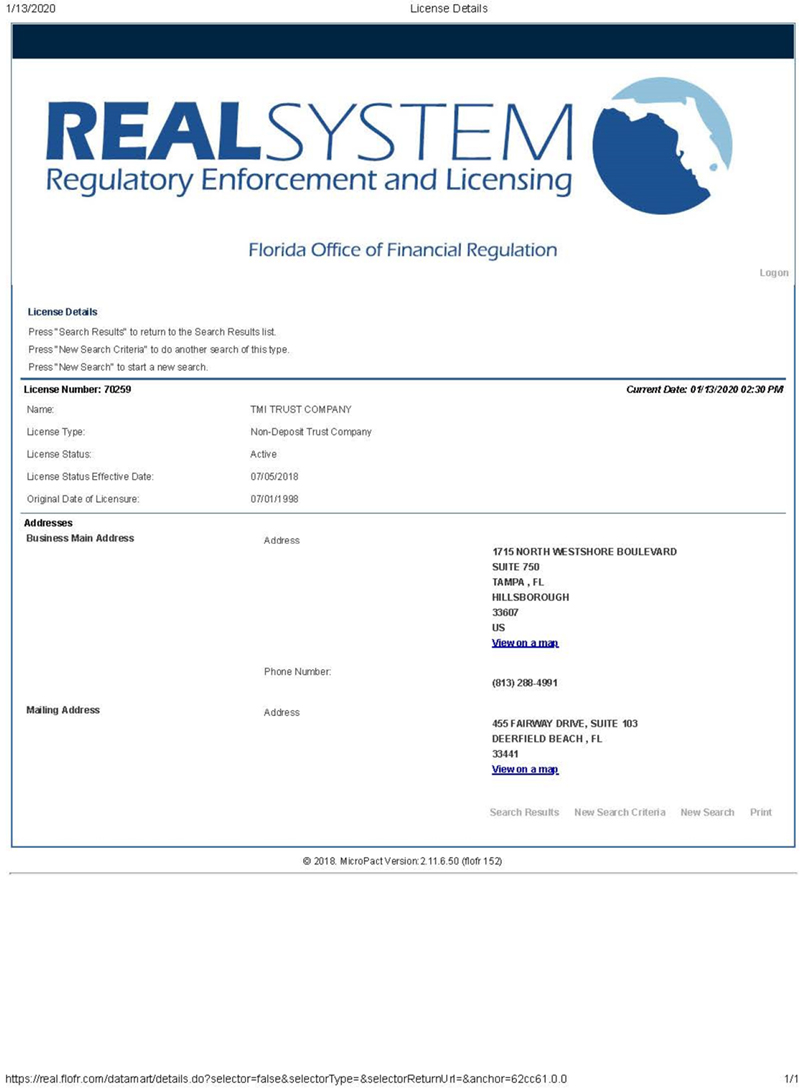
EXHIBIT 4
BYLAWS OF THE TRUSTEE
AMENDED AND RESTATED BYLAWS
OF
TMI TRUST COMPANY
TMI TRUST COMPANY
AMENDED AND RESTATED BYLAWS
TABLE OF CONTENTS
| Article/Section Number | Description | Page |
| ARTICLE I | OFFICES OF THE TRUST COMPANY | 1 |
| 1.01 | Principal Office | 1 |
| 1.02 | Other Offices | 1 |
| ARTICLE II | SHAREHOLDERS | 1 |
| 2.01 | Place of Meeting | 1 |
| 2.02 | Annual Meetings | 1 |
| 2.03 | Special Meetings | 1 |
| 2.04 | Shareholder Lists | 1 |
| 2.05 | Notice of Meetings | 1 |
| 2.06 | Waivers of Notice | 2 |
| 2.07 | Quorum of Shareholders | 2 |
| 2.08 | Action by Shareholders | 2 |
| 2.09 | Voting and Proxies | 2 |
| 2.10 | Action by Unanimous Written Consent | 3 |
| ARTICLE III | DIRECTORS | 3 |
| 3.01 | Powers of Directors | 3 |
| 3.02 | Number and Qualifications | 3 |
| 3.03 | Filling of Vacancies | 3 |
| 3.04 | Resignation of Directors | 4 |
| 3.05 | Removal of Directors | 4 |
| 3.06 | Place of Meetings | 4 |
| 3.07 | Chairman of the Board | 4 |
| 3.08 | First Meetings | 4 |
| 3.09 | Regular Meetings | 4 |
| 3.10 | Special Meetings | 4 |
| 3.11 | Quorum of Directors | 4 |
| 3.12 | Action by Written Consent. Fax and Electronic Mail | 4 |
| 3.13 | Compensation of Directors | 5 |
| 3.14 | Minutes of Meetings | 5 |
| ARTICLE IV | NOTICES AND TELEPHONE MEETINGS | 5 |
| 4.01 | Method of Giving Notice | 5 |
| 4.02 | Waiver of Notice | 5 |
| 4.03 | Telephone Meetings | 5 |
| ARTICLE V | OFFICERS | 6 |
| 5.01 | Qualifications | 6 |
| 5.02 | Compensation of Officers | 6 |
| 5.03 | Term and Vacancies | 6 |
| 5.04 | Removal of Officers | 6 |
| 5.05 | Resignation of Officers | 7 |
| 5.06 | General Authority of Officers | 7 |
| 5.07 | Execution of Instruments | 7 |
| ARTICLE VI | COMMITTEES | 7 |
| 6.01 | Executive Committee | 7 |
| 6.02 | Audit Committee | 8 |
| 6.03 | Other Committees | 8 |
| 6.04 | Removal | 8 |
| ARTICLE VII | CERTIFICATES AND SHAREHOLDERS | 8 |
| 7.01 | Form of Certificates | 8 |
| 7.02 | Lost Certificates | 9 |
| 7.03 | Transfer of Shares | 9 |
| 7.04 | Record Ownership Conclusive | 9 |
| 7.05 | Closing Transfer Books | 9 |
| ARTICLE VIII | Fiduciary Provisions | 10 |
| 8.01 | Fiduciary Files | 10 |
| 8.02 | Trust Investments | 10 |
| ARTICLE IX | ||
| OTHER PROVISIONS | 10 | |
| 9.01 | Distributions | 10 |
| 9.02 | Reserves | 10 |
| 9.03 | Records | 11 |
| 9.04 | Fiscal Year | 11 |
| 9.05 | Seal | 11 |
| 9.06 | Indemnification | 11 |
| 9.07 | Other Indemnification | 11 |
| 9.08 | Insurance | 11 |
| 9.09 | Transactions Between the Trust Company and an Officer, Director, or Shareholder | 11 |
| ARTICLE X | AMENDMENT AND CONSTRUCTION | 12 |
| 10.01 | Amendment | 12 |
| 10.02 | Severability | 12 |
AMENDED AND RESTATED BYLAWS
OF
TMI TRUST COMPANY
ARTICLE I
OFFICES OF THE TRUST COMPANY
1.01 Principal Office. The principal office of the trust company shall be located in Tampa, Hillsborough County, Florida.
1.02 Other Offices. The trust company may, subject to compliance with all applicable laws and regulations, have offices at such other places as the board of directors may from time to time determine or as the affairs of the trust company may require.
ARTICLE II
SHAREHOLDERS
2.01 Place of Meeting. All meetings of shareholders for any purpose shall be held at the principal office of the trust company or at such place, either within or without the State of Florida, as shall be stated in the notice of the meeting or in a duly executed waiver of notice thereof.
2.02 Annual Meetings. The annual meeting of shareholders shall be held no later than April 30 on such date, time and place as determined by the Board of Directors of the Company each year by resolution of the board of directors and specified in the notice of the meeting. At each such annual meeting, the shareholders shall elect a board of directors and transact such other business as may be properly brought before the meeting.
2.03 Special Meetings. Special meetings of the shareholders may be called for any purpose at any time by the chairman of the board, chief executive officer, the board of directors, or the holders of not less than fifty percent (50%) of all the shares entitled to vote at the meeting.
2.04 Shareholder Lists. At least ten (10) days before each meeting of shareholders, a complete list of the shareholders entitled to vote at such meeting, arranged in alphabetical order, with the address of each and number of voting shares held by each, shall be prepared by the officer or agent having charge of the stock transfer books. For a period of ten (10) days prior to the meeting, the list shall be kept on file at the principal office of the trust company and shall be subject to inspection by any shareholder at any time during usual business hours. The list shall also be produced and kept open at the time and place of the meeting and shall be subject to inspection by any shareholder during the whole time of the meeting.
2.05 Notice of Meetings. Written notice stating the place, day and time of the meeting and, in the case of a special meeting, the purposes for which the meeting is called, shall be delivered not less than ten (10) nor more than sixty (60) days before the date thereof, either personally or by mail, by or at the direction of the president, the secretary or the officer or other persons calling the meeting, to each shareholder of record entitled to vote at such meeting. Only business within the purpose or purposes described in the notice required herein may be conducted at a special meeting of the shareholders. If mailed, notice shall be deemed to be delivered when deposited in the United States mail, postage prepaid, addressed to the shareholder at the shareholder’s address as it appears on the stock transfer books of the trust company.
2.06 Waivers of Notice. Whenever any notice is required to be given to any shareholder, under these bylaws, the articles of incorporation, or the laws of the State of Florida, a written waiver of notice, signed anytime by the person entitled to notice shall be equivalent to giving notice. Attendance by a shareholder entitled to vote at a meeting, in person or by proxy, shall constitute a waiver of (a) notice of the meeting, except when the shareholder attends a meeting solely for the purpose, expressed at the beginning of the meeting, of objecting to the transaction of any business because the meeting is not lawfully called or convened, and (b) an objection to consideration of a particular matter at the meeting that is not within the purpose of the meeting unless the shareholders object to considering the matter when it is presented.
2.07 Quorum of Shareholders. The holders of a majority of the shares issued and outstanding and entitled to vote at such meeting, present in person or by proxy, shall be requisite and shall constitute a quorum for the transaction of business at all meetings of shareholders, except as otherwise provided by statute, the articles of incorporation, or these bylaws. If a quorum is not present or represented at any meeting of shareholders, the shareholders entitled to vote thereat, present in person or represented by proxy, shall have the power to adjourn the meeting from time to time, without notice other than announcement at the meeting, until a quorum is present or represented. At any continuation of a meeting following such adjournment at which a quorum is present or represented, any business may be transacted which might have been transacted at the meeting as originally notified.
2.08 Action by Shareholders. When a quorum is present at any meeting, the affirmative vote of the holders of the majority of the shares entitled to vote on, and who voted for, against, or expressly abstained with respect to, the matter at a shareholders’ meeting is the act of the shareholders, unless the question is one upon which a different vote is required by statute, the articles of incorporation, or these bylaws. The shareholders present at a duly organized meeting may continue to transact business until adjournment, notwithstanding the withdrawal of enough shares to leave less than a quorum.
2.09 Voting and Proxies. Cumulative voting in the election of directors shall not be permitted. Each outstanding share having voting power shall be entitled to one vote on each matter submitted to a vote at a meeting of the shareholders. A shareholder may vote either in person or by proxy executed in writing by the shareholder or by his duly authorized attorney-in-fact, but no proxy shall be valid after eleven (11) months from the date of its execution, unless otherwise expressly provided in the proxy. Each proxy shall be revocable unless the proxy form conspicuously states that the proxy is irrevocable and the proxy is coupled with an interest (which includes the appointment as proxy of a pledgee; a person who purchased or agreed to purchase, or owns or holds an option to purchase, the shares; a creditor of the trust company who extended it credit under terms requiring the appointment; an employee of the trust company whose employment contract requires the appointment; and a party to a voting agreement validly created under the laws of the State of Florida). Each proxy shall be filed with the secretary of the trust company prior to or at the time of the meeting. Any vote must be taken by written ballot upon the oral or written request of any shareholder.
2.10 Action by Unanimous Written Consent. Any action required or permitted by statute to be taken at a meeting of the shareholders may be taken without a meeting, without prior notice, and without a vote, if a consent in writing, setting forth the action so taken, shall be signed by the holder or holders of shares having not less than the minimum number of votes that would be necessary to take such action at a meeting at which the holders of all shares entitled to vote on such action were present and voting. Any such signed consent, or a copy thereof, shall be placed in the minute book of the trust company.
ARTICLE III
DIRECTORS
3.01 Powers of Directors. The business and affairs of the trust company shall be managed by its board of directors, which may exercise all powers of the trust company and do all lawful acts and things as are not by statute, the articles of incorporation, or these bylaws, directed or required to be exercised or done by the shareholders.
3.02 Number and Qualifications. The board of directors shall consist of not less than seven (7) nor more than twenty-five (25) directors, the majority of whom shall be residents of the State of Florida. Directors need not be shareholders of the trust company. The number of directors may be increased (to not more than 25) or decreased (but not below 7) from time to time by resolution adopted by the board of directors but may not be increased by more than two (2) between annual meetings. Prior to taking office, each director shall take oath that he/she accepts the position as director; that he will not violate, nor knowingly permit any officer, director, or employee of the trust company to violate the laws of the State of Florida in the conduct of the business of the trust company; and that he/she will diligently perform his duties as director. Such affidavit shall be sworn and subscribed to and spread upon the minutes of the directors’ meeting. Without the prior written consent of the Florida Office of Financial Regulation, no person shall be nominated to serve as a director or shall serve as a director if (i) the trust company holds a judgment against such person; (ii) the trust company holds a charged-off obligation on which such person is liable; or (iii) such person has been convicted of a felony. Each director elected shall serve until his successor shall have been elected and qualified.
3.03 Filling of Vacancies. A vacancy occurring in the board of directors by reason of death, resignation, or removal may be filled by the Board of Directors of the Company by an affirmative vote of a majority of the remaining directors, although less than a quorum of the board of directors. A director elected to fill a vacancy shall be elected for the unexpired term of his predecessor in office. Any directorship to be filled by reason of an increase in the number of directors may be filled by election at an annual or special meeting of shareholders called for that purpose; provided that, if authorized by a resolution of the shareholders, the board of directors, without action by the shareholders, may fill up to two such directorships during any one year.
3.04 Resignation of Directors. Any director may resign from his office at any time by delivering his written resignation to the secretary of the trust company, and such resignation shall be effective immediately upon delivery to the secretary.
3.05 Removal of Directors. Any director may be removed with or without cause at any special meeting of shareholders, by the affirmative vote of a majority of the number of shares of the shareholders present in person or by proxy at such meeting and entitled to vote for the election of such director, if notice of intention to act upon such matter shall have been given in the notice calling such meeting.
3.06 Place of Meetings. Regular or special meetings of the board of directors may be held either within or without the State of Florida.
3.07 Chairman of the Board. The chairman of the board of directors, if one be elected by the board of directors, shall preside at all meetings of the board of directors, if the chairman of the board is also an employee of the company, then such chairman shall also serve as an executive officer of the Company.
3.08 First Meetings. The first meeting of each newly elected board of directors shall be held at such time and place as shall be fixed by the vote of the shareholders at the annual meeting and no notice of such meeting to the newly elected directors shall be necessary in order to legally constitute the meeting, provided a quorum of duly qualified directors shall be present. If the shareholders fail to fix the time and place of such first meeting, it shall be held without notice immediately following, and at the same place as the annual meeting of the shareholders; provided, however, that if at least a majority (but not less than 5) of the newly elected directors are not present and qualified, such initial meeting shall be adjourned by those directors who are present and have qualified until the necessary majority of directors have been qualified and can be convened at a meeting to be called by the president. Until such initial meeting of the newly elected directors is held, the prior board of directors shall continue in office.
3.09 Regular Meetings. Regular meetings of the board of directors shall be held at least quarterly, and may be held without notice at such time and place as shall from time to time be determined by resolutions of the board of directors.
3.10 Special Meetings. Special meetings of the board of directors may be called by the chairman of the board of directors or the chief executive officer and shall be called by the secretary on the written request of three (3) directors. Notice of any special meeting of the board of directors shall be given to each director at least two (2) days before the date of the meeting.
3.11 Quorum of Directors. At all meetings of the board of directors, a majority of the directors shall constitute a quorum for the transaction of business and the act of a majority of the directors present at any meeting at which there is a quorum shall be the act of the board of directors. If a quorum shall not be present at any meeting of the directors, the directors present thereat may adjourn the meeting from time to time, without notice other than announcement at the meeting, until a quorum shall be present.
3.12 Action by Written Consent, Fax and Electronic Mail. Any action required or permitted to be taken at a meeting of the board of directors or any committee may be taken without a meeting if a consent in writing, setting forth the actions so taken, is signed by all of the members of the board of directors or such committee, as the case may be. Written consents of directors sent by facsimile transmission or electronic mail shall be accepted and effective for all purposes.
3.13 Compensation of Directors. By resolution of the board of directors, the directors may be paid their expenses, if any, of attending each meeting of the board of directors and may be paid a fixed sum for attending each meeting of the board of directors or a stated salary for serving as a director. No such payment shall preclude any director from serving the trust company in any other capacity and receiving compensation therefor. Members of the executive committee or of special or standing committees may, by resolution of the board of directors, be allowed like compensation for attending committee meetings.
3.14 Minutes of Meetings. The board of directors shall keep regular minutes of its proceedings and such minutes shall be placed in the minute book or electronic equivalent of the trust company. Committees of the board of directors shall maintain a separate record of the minutes of their proceedings, which shall also be placed in the corporate minute book or electronic equivalent.
ARTICLE IV
NOTICES AND TELEPHONE MEETINGS
4.01 Method of Giving Notice. Any notice to directors or shareholders shall be in writing and shall be delivered personally or mailed to the directors or shareholders at their respective addresses appearing on the books of the trust company. Notice by mail shall be deemed to be given at the time when the same shall be deposited in the United States mail, postage prepaid. Notices of meetings and written consents of directors sent by facsimile transmission or electronic mail shall be accepted and effective for all purposes. Any notice required to be given to shareholders, under these bylaws, the articles of incorporation, or the laws of the State of Florida, need not be given to a shareholder if (a) notice of two consecutive annual meetings and all notices of meetings held during the period between those annual meetings, if any, or (b) all (but in no event less than two) payments (if sent by first class mail) of distributions or interest on securities during a twelve month period have been mailed to that person, addressed at this address as shown on the records of the trust company, and have been returned undeliverable. Any action or meeting taken or held without notice to such a person shall have the same force and effect as if the notice had been duly given. If such a person delivers to the trust company a written notice setting forth his then current address, requirement that notice be given to that person shall be reinstated.
4.02 Waiver of Notice. Any notice required to be given may be subject to a waiver thereof in writing signed by the person or persons entitled to receive such notice, whether before or after the time stated therein, and such waiver shall be deemed equivalent to the giving of such notice in a timely manner. Any such signed waiver of notice, or a signed copy thereof, shall be placed in the minute book of the trust company. Attendance of such persons at any meeting shall constitute a waiver of notice of such meetings, except where the persons attend for the express purpose of objecting that the meeting is not lawfully convened.
4.03 Telephone Meetings. Subject to the requirements of the Florida Business Corporation Act, or these bylaws for notice of meetings, shareholders, members of the board or directors, or members of any committee designated by such board of directors may participate in and hold a meeting of such shareholders, board of directors, or committee by means of a conference telephone or similar communications equipment by means of which all persons participating in the meeting can hear each other, and participation in a meeting pursuant to this Section 4.03 shall constitute presence in person at such meeting, except where a person participates in the meeting for the express purpose of objecting to the transaction of any business on the ground that the meeting is not lawfully called or convened.
ARTICLE V
OFFICERS
5.01 Qualifications. The officers of the trust company need not be shareholders of the trust company or residents of the State of Florida. The board of directors shall elect annually a chief executive officer (who may also be a member of the board of directors), a president (who may also be a member of the board of directors), a treasurer, one or more division presidents, one or more vice chairmen, and a secretary responsible for maintenance of the trust company’s corporate books and records and for the required attestation of signatures. The secretary and the president may not be the same person. Such other officers and assistant officers as the board of directors may deem desirable shall be appointed and removed in such other manner as may be prescribed by the board. Except for the offices of president and secretary, any two (2) or more offices may be held by the same person. Any person holding the title of vice president or below may be elected as an officer of the company upon the approval of either the chairman or CEO of the company and such approval shall be in writing and maintained in the permanent records of the company.
5.02 Compensation of Officers. The salaries of all officers of the trust company, with the exception of the chairman of the board if such chairman is deemed an executive officer of the company shall be fixed by either the chairman of the board, if such chairman is an executive officer of the company, or the CEO; the chairman’s salary, if an executive officer of the company, shall be fixed by the Board of Directors of the Company or a committee thereof. The executive officers of the company shall have the power to enter into contracts for the employment and compensation of officers on such terms as the executive officer deems advisable. No officer shall be disqualified from receiving a salary or other compensation by reason of the fact that he is also a director of the trust company.
5.03 Term and Vacancies. The officers of the trust company shall hold office until their successors are elected or appointed and qualified, or until their death, resignation, or removal from office. Any vacancy occurring in any office of the trust company by death, resignation, removal, or otherwise, may be filled by the chairman or CEO of the company except for the a vacancy in the role of chairman which shall be filled by the Board of Directors of the Company.
5.04 Removal of Officers. Any officer elected or appointed may be removed at any time by the board of directors, but such removal shall be without prejudice to the contract rights, if any, of the person so removed. Election or appointment of an officer or employee shall not of itself create contract rights. Any officer may be removed, either with or without cause, by the board of directors, at any regular or special meeting, or, except in the case of an officer chosen by the board of directors, by any officer upon whom such power of removal may be conferred by the board of directors.
5.05 Resignation of Officers. Any officer may resign at any time by giving written notice to the board of directors, or to the president, or the secretary of the trust company. Any such resignation shall take effect at the date of the receipt of such notice or at any later specified time; and, unless otherwise specified, the acceptance of such resignation shall not be necessary to make it effective.
5.06 General Authority of Officers. The board of directors, except as otherwise provided in these bylaws, may authorize any officer to enter into any contract or execute and deliver any instrument in the name of and on behalf of the trust company, and such authority may be general or confined to specific instances. Unless so authorized, no officer, agent or employee shall have any power or authority to bind the trust company by any contract or engagement or to pledge its credit or to render it liable pecuniarily for any purpose or in any amount.
5.07 Execution of Instruments. All documents, instruments or writings of any nature shall be signed, executed, verified, acknowledged or delivered by such officer and officers or such agent or agents of the trust company and in such manner as the board of directors may from time to time determine.
ARTICLE VI
COMMITTEES
6.01 Executive Committee. The board of directors may, by resolution adopted by a majority of the entire board, designate an executive committee consisting of one or more directors. Each executive committee member shall hold office until the first meeting of the board of directors after the annual meeting of shareholders and until the member’s successor is elected and qualified, or until the member’s death, resignation or removal, or until the member shall cease to be a director.
During the intervals between the meetings of the board of directors, the executive committee may exercise all the authority of the board of directors; provided, however, that the executive committee shall not have the power to amend or repeal any resolution of the board of directors that by its terms shall not be subject to amendment or repeal by the executive committee, and the executive committee shall not have the authority of the board of directors in reference to (i) the amendment of the Articles of Incorporation or Bylaws of the corporation; (ii) the adoption of a plan of merger or consolidation; (iii) the sale, lease, exchange or other disposition of all or substantially all the property and assets of the corporation; or (iv) a voluntary dissolution of the corporation or the revocation of any such voluntary dissolution.
The executive committee shall meet from time to time on call of the chairman of the board or the president or of any two or more members of the executive committee. Meetings of the executive committee may be held at such place or places, within or without the State of Florida, as the executive committee shall determine or as may be specified or fixed in the respective notices or waivers of such meetings. The executive committee may fix its own rules of procedure, including provision for notice of its meetings. It shall keep a record of its proceedings and shall report these proceedings to the board of directors at the meeting thereof held next after they have been taken, and all such proceedings shall be subject to revision or alteration by the board of directors except to the extent that action shall have been taken pursuant to or in reliance upon such proceedings prior to any such revision or alteration.
The executive committee shall act by majority vote of its members; provided, however, that contracts or transactions of and by the corporation in which officers or directors of the corporation are interested shall require the affirmative vote of a majority of the disinterested members of the executive committee at a meeting of the executive committee at which the material facts as to the interest and as to the contract or transaction are disclosed or known to the members of the executive committee prior to the vote.
Members of the executive committee may participate in committee proceedings by means of conference telephone or similar communications equipment by means of which all persons participating in the proceedings can hear each other, and such participation shall constitute presence in person at such proceedings.
The board of directors may by resolution designate one or more directors as alternate members of the executive committee who may act in the place and stead of any absent member or members at any meeting of said committee.
6.02 Audit Committee. The board of directors may, by resolution adopted by a majority of the entire board, designate an audit committee consisting of at least three members. Each member shall be a capable and experienced individual with at least two being directors of the Holding Company or Trust Company. Each audit committee member shall hold office until the first meeting of the board of directors after the annual meeting of shareholders and until the member’s successor is elected and qualified, or until the member’s death, resignation or removal. The audit committee shall meet as often as required to fulfill its responsibilities, but no less than once quarterly. The committee shall maintain minutes of its meetings.
6.03 Other Committees. The board of directors, by resolution passed by a majority of the entire board of directors, may from time to time designate members of the board of directors to constitute other committees, which shall in each case consist of such number of directors, not less than two (2), and shall have and may exercise such powers as the board of directors may determine and specify in the respective resolutions appointing them. A majority of all the members of any such committee may determine its action and fix the time and place of any meeting, unless the board of directors shall otherwise direct. The board of directors shall have power at any time to change the number and the members (with or without cause) of any such committee, to fill vacancies and to discharge any such committee.
6.04 Removal. The board of directors shall have power at any time to remove any member of any committee, with or without cause, and to fill vacancies in and to dissolve any such committee.
ARTICLE VII
CERTIFICATES AND SHAREHOLDERS
7.01 Form of Certificates. Certificates shall be delivered representing all shares of stock in the trust company to which shareholders are entitled. Certificates for shares of stock of the trust company shall be in such form as shall be required by law and as shall be approved by the board of directors. Every certificate for shares issued by the trust company must be signed (such signatures may be facsimiles) by the president or a vice president and the secretary or an assistant secretary. Such certificates shall bear a legend or legends in the form and containing the restrictions required to be stated thereon by the Florida Business Corporation Act, other provisions of law, the articles of incorporation or these bylaws. Certificates shall be consecutively numbered and shall be recorded in the books of the trust company as they are issued. Each certificate shall state on the face thereof the holder’s name, the number and class of shares, the par value of such shares, and such other matters as may be required by law, the articles of incorporation or these bylaws.
7.02 Lost Certificates. The board of directors may direct a new certificate or certificates to be issued in place of any certificate previously issued by the trust company alleged to have been lost or destroyed, upon the making of an affidavit of that fact by the person claiming the loss or destruction. In so doing, the board of directors may in its discretion and as a condition precedent to the issuance of a new certificate (a) require the owner of the lost or destroyed certificate or such owner’s legal representative, to advertise the same in such manner as it shall require and/or (b) to give the trust company a bond (with a surety or sureties satisfactory to the trust company) in such sum as it may direct, as indemnity against any claim, or expense resulting from any claim that may be made against the trust company with respect to the certificate alleged to have been lost or destroyed.
7.03 Transfer of Shares. Shares of stock shall be transferable only on the books of the trust company by the holder thereof in person or by such holder’s duly authorized attorney. Upon surrender to the trust company or its transfer agent of a certificate representing shares properly endorsed or accompanied by proper evidence of succession, assignment or authority to transfer, the trust company or its transfer agent shall issue a new certificate to the person entitled thereto, cancel the old certificate and record the transaction upon its books.
7.04 Record Ownership Conclusive. The trust company shall be entitled to treat the holder of record of any share or shares of stock in the trust company as the holder in fact thereof and, accordingly, shall not be bound to recognize any equitable or other claim to or interest in such share or shares on the part of any other person, whether or not it has express or other notice thereof, except as otherwise provided by law or by any stock purchase and redemption agreement to which the stock may be subject, if such agreement has been formally executed or accepted by the trust company. When shares are registered on the books of the trust company in the names of two or more persons as joint owners with the right of survivorship, after the death of a joint owner and before the time that the trust company receives actual written notice that parties other than the surviving joint owner or owners claim an interest in the shares or any distributions thereon, the trust company may record on its books and otherwise effect the transfer of those shares to any person, firm, or trust company (including that surviving joint owner individually) and pay any distributions made in respect of those shares, in each case as if the surviving joint owner or owners were the absolute owners of the shares.
7.05 Closing Transfer Books. The board of directors shall have the power to close the stock transfer books of the trust company for a period not exceeding sixty (60) days preceding the date of any meeting of the shareholders or the date for payment of any distribution by the trust company (other than a distribution involving a purchase or redemption by the trust company of any of its own shares) or a share dividend or the date for the allotment of rights or the date when any change or conversion or exchange of capital stock shall go into effect. In lieu of closing the stock transfer books, the board of directors may fix in advance a date, not exceeding sixty (60) days preceding the date of any meeting of shareholders, or the date for the payment of any distribution by the trust company (other than a distribution involving a purchase or redemption by the trust company of any of its own shares) or a share dividend, or the date for allotment of rights, or the date when any change or conversion or exchange of capital stock shall go into effect, as a record date for the determination of the shareholders entitled to notice of and to vote at any such meeting, or entitled to receive payment of any such distribution or share dividend, or any such allotment of rights, or to exercise the rights in respect to any such change, conversion, or exchange of capital stock, and in such case only shareholders of record on the date so fixed shall be entitled to such notice of and to vote at such meeting, or to receive payment of such distribution or share dividend, or allotment of rights, or exercise such rights, as the case may be, and notwithstanding any transfer of any stock on the books of the trust company after any such record date fixed as herein provided.
ARTICLE VIII
FIDUCIARY PROVISIONS
8.01 Fiduciary Files. There shall be maintained by the trust company all fiduciary records necessary to assure that its fiduciary responsibilities have been properly undertaken and discharged.
8.02 Trust Investments. Funds held in a fiduciary capacity shall be invested in accordance with the instrument establishing the fiduciary relationship and local law. Where such instrument does not specify the character and class investment to be made and does not vest in the trust company a discretion in the matter, funds held pursuant to such instrument shall be invested in investments in which corporate fiduciaries may invest under applicable law.
ARTICLE IX
OTHER PROVISIONS
9.01 Distributions. The board of directors may authorize the trust company, at any regular or special meeting of the directors, to make distributions and to declare share dividends subject to the provisions of the articles of incorporation and the laws of the State: of Florida. Such distribution may be in the form of cash or, in the case of share dividends, in shares of the trust company. The authorization for distributions and share dividends shall be at the discretion of the board of directors.
9.02 Reserves. Before payment of any distribution, the board of directors shall create and Set aside funds and reserves as required by applicable law or as the directors from time to time and in their absolute discretion think proper to provide for contingencies or to equalize distributions or to repair or maintain any property of the trust company, or for any other purpose they think beneficial to the trust company. Subject to the requirements of applicable law, the directors may modify or abolish any such reserve or fund in the manner in which it was created.
9.03 Records. The trust company shall keep correct and complete books and records of account and shall keep minutes of the proceedings of its shareholders and board of directors, and shall keep at its registered office or principal place of business or at the office of its transfer agent or registrar a record of its shareholders, giving the names and addresses of all shareholders and the number and class of the shares held by each.
9.04 Fiscal Year. The fiscal year of the trust company shall, unless otherwise fixed by resolution of the board of directors, be the calendar year.
9.05 Seal. The trust company’s seal shall be in such form as may be prescribed by the board of directors. The seal may be used by causing it or a facsimile thereof to be impressed or affixed or in any manner reproduced. The seal need not be affixed to any document signed on behalf of the trust company unless specifically required by resolution of the board of directors.
9.06 Indemnification. The trust company shall indemnify and hold harmless each person who was or is a director or executive officer of the trust company and may indemnify any other person, including any person who was or is serving as a director, officer, fiduciary or other representative of another entity at the request of the trust company, and each such person’s heirs and legal representatives to the fullest extent provided in the trust company’s articles of incorporation.
9.07 Other Indemnification. The foregoing rights of indemnification and reimbursement shall not be exclusive of any other right to which any such person may be entitled by law, bylaw, agreement, shareholder’s vote or otherwise.
9.08 Insurance. The trust company shall have the power to purchase and maintain insurance on behalf of any person who is or was a director, officer, employee or agent of the trust company or who was serving at the request of the association as a director, officer, employee or agent of another corporation, partnership, joint venture, trust or other enterprise against any liability asserted against such person and incurred by such person in any such capacity or arising out of such person’s status as such, whether or not the trust company would have the power to indemnify such person against such person under the trust company’s articles of incorporation.
9.09 Transactions Between the Trust Company and an Officer, Director, or Shareholder. No contract or other transaction between the trust company and any of its directors, officers or any trust company or other organization in which any of them are directly or indirectly interested, shall be void or voidable solely by reason of the interest or relationship of such director or officer if:
| (1) | the material facts of the relationship or interest of each such director, officer or security holder are known or disclosed: |
| (a) | to the board of directors and it nevertheless authorizes or ratifies the contract or transaction by a majority of the directors present, each such interested director to be counted in determining whether a quorum is present but not in calculating the majority necessary to carry the vote; or |
| (b) | to the shareholders and they nevertheless authorize or ratify the contract or transaction by a majority of the shares present, each such interested person to be counted for quorum and voting purposes; or |
| (2) | the contract or transaction is fair to the trust company as of the time it is authorized or ratified by the board of directors, or the shareholders. |
ARTICLE X
AMENDMENT AND CONSTRUCTION
10.01 Amendment. The board of directors shall have the power to alter, amend, or repeal these bylaws or adopt new bylaws, subject to the right of the shareholders to rescind any board action with regard to the bylaws at a regular meeting of shareholders or at a special meeting of shareholders called for such purpose.
10.02 Severability. If any portion of these bylaws shall be invalid or inoperative, then, so far as is reasonable, the remainder of these bylaws shall be considered valid.
The undersigned, the secretary of the trust company, hereby certifies that the foregoing bylaws were adopted by the board of directors of the trust company as of April 30, 2019.
| Robert C. Finely, Secretary |
EXHIBIT 6
CONSENT OF THE TRUSTEE
Pursuant to the requirements of Section 321(b) of the Trust Indenture Act of 1939, and in connection with the proposed issue of debt securities, Argent Institutional Trust Company hereby consents that reports of examinations by Federal, State, Territorial or District authorities may be furnished by such authorities to the Securities and Exchange Commission upon request therefore.
| ARGENT INSTITUTIONAL TRUST COMPANY | ||
| By: | /s/ Debra Schachel | |
| Vice President | ||
Atlanta, Georgia
April 17, 2025
EXHIBIT 7
CONSOLIDATED REPORT OF CONDITION OF
TMI TRUST COMPANY
TMI TRUST COMPANY
STATEMENTS OF FINANCIAL CONDITION
DECEMBER 31, 2022 AND 2021
| 2022 | 2021 | |||||||
| ASSETS | ||||||||
| Cash and cash equivalents | $ | 3,306,165 | $ | 2,035,448 | ||||
| Investment securities held to maturity, at cost | 322,357 | 321,083 | ||||||
| Accounts receivable, net | 4,374,010 | 591,898 | ||||||
| Fee receivables | 2,773,466 | 2,038,355 | ||||||
| Receivables from trusts | 76,658 | - | ||||||
| Prepaid expenses | 682,187 | 581,442 | ||||||
| Property and equipment, net | 198,162 | 213,981 | ||||||
| Goodwill | 637,000 | 637,000 | ||||||
| Intangible assets, net | 3,915,034 | 1,334,921 | ||||||
| Finance lease right-of-use assets | 100,449 | - | ||||||
| Operating lease right-of-use assets | 1,521,118 | - | ||||||
| Deferred tax asset, net | 159,230 | 137,802 | ||||||
| Other assets | 32,086 | 32,086 | ||||||
| Total Assets | $ | 18,097,922 | $ | 7,924,016 | ||||
| LIABILITIES AND STOCKHOLDERS’ EQUITY | ||||||||
| Liabilities: | ||||||||
| Accounts payable and accrued expenses | $ | 2,642,362 | $ | 1,280,229 | ||||
| Deferred fee income | 565,149 | 575,589 | ||||||
| Operating lease liabilities | 1,542,849 | - | ||||||
| Finance lease liabilities | 98,707 | - | ||||||
| Earnout liabilities | 3,421,240 | 1,019,849 | ||||||
| Intercompany tax payable | 610,479 | - | ||||||
| Other liabilities | 186,539 | 158,545 | ||||||
| Total Liabilities | 9,067,325 | 3,034,212 | ||||||
| Commitments and contingencies (Notes 11) | ||||||||
| Stockholders’ Equity: | ||||||||
| Common stock; $12.50 par value per share; 1,000,000 shares authorized; 100,000 shares issued and outstanding | 1,250,000 | 1,250,000 | ||||||
| Paid-in capital | 3,585,707 | 3,585,707 | ||||||
| Retained earnings | 4,194,890 | 54,097 | ||||||
| Total Stockholders’ Equity | 9,030,597 | 4,889,804 | ||||||
| Total Liabilities and Stockholders’ Equity | $ | 18,097,922 | $ | 7,924,016 | ||||
The accompanying notes to the financial statements are an integral part of these statements.
3
TMI TRUST COMPANY
STATEMENTS OF OPERATIONS
YEAR ENDED DECEMBER 31, 2022 AND 2021
| 2022 | 2021 | |||||||
| Revenues: | ||||||||
| Fee Income: | ||||||||
| IRA services | $ | 1,552,938 | $ | 1,862,318 | ||||
| Corporate trust and agency services | 5,287,849 | 4,405,846 | ||||||
| Family office services | 1,871,335 | 2,003,205 | ||||||
| Salem Trust and custody services | 5,136,415 | 4,480,161 | ||||||
| Agency and trust services | 676,561 | 612,775 | ||||||
| SBA custody services | 2,441,506 | 1,878,691 | ||||||
| Other income | 167,296 | 2,767 | ||||||
| Total Fee Income | 17,133,900 | 15,245,763 | ||||||
| Interest income | 7,571,384 | 800,557 | ||||||
| Total Revenues | 24,705,284 | 16,046,320 | ||||||
| Expenses: | ||||||||
| Employee compensation and benefits | 10,303,838 | 8,791,335 | ||||||
| Technology and outsourcing | 3,691,918 | 3,270,180 | ||||||
| Travel | 192,642 | 100,164 | ||||||
| Postage | 77,479 | 60,164 | ||||||
| Supplies and printing | 197,984 | 180,387 | ||||||
| Depreciation and amortization | 413,135 | 303,597 | ||||||
| Occupancy | 609,995 | 575,942 | ||||||
| Professional fees | 413,465 | 135,731 | ||||||
| Insurance | 449,868 | 437,750 | ||||||
| Interest expense | 15,532 | 15,341 | ||||||
| Intercompany administrative services agreement (See Note 13) | 1,110,000 | 1,140,000 | ||||||
| Charge-offs (recoveries), net | 342,801 | 89,215 | ||||||
| Earnout liability fair value adjustment | 224,897 | - | ||||||
| Other | 1,165,267 | 1,179,383 | ||||||
| Total Expenses | 19,208,821 | 16,279,189 | ||||||
| Income (Loss) Before Income Taxes | 5,496,463 | (232,869 | ) | |||||
| Income Tax Expense (Benefit): | ||||||||
| Federal | 1,098,655 | (45,837 | ) | |||||
| State | 257,015 | 15,479 | ||||||
| Total Income Tax Expense (Benefit) | 1,355,670 | (30,358 | ) | |||||
| Net Income (Loss) | $ | 4,140,793 | $ | (202,511 | ) | |||
The accompanying notes to the financial statements are an integral part of these statements.
4
|
Security Type
|
Security Class Title
|
Fee Calculation Rule
|
Amount
Registered
|
Proposed Maximum Offering Price Per Security
|
Maximum Aggregate Offering Price
|
Fee Rate
|
Amount of
Registration Fee
|
Carry
Forward
Form Type
|
Carry
Forward
File Number
|
Carry
Forward
Initial
Effective Date
|
Filing Fee Previously Paid In Connection with Unsold Securities to be Carried Forward
|
|
|
Newly Registered Securities
|
||||||||||||
|
Fees to Be Paid
|
Equity
|
Common Stock, par value $0.01 per share
|
(1)
|
(1)
|
(1)
|
(1)
|
(1)
|
(1)
|
-
|
-
|
-
|
-
|
|
Fees to Be Paid
|
Equity
|
Preferred Stock, par value $0.01 per share
|
(1)
|
(1)
|
(1)
|
(1)
|
(1)
|
(1)
|
-
|
-
|
-
|
-
|
|
Fees to Be Paid
|
Debt
|
Debt Securities
|
(1)
|
(1)
|
(1)
|
(1)
|
(1)
|
(1)
|
-
|
-
|
-
|
-
|
|
Fees to Be Paid
|
Other
|
Warrants(2)
|
(1)
|
(1)
|
(1)
|
(1)
|
(1)
|
(1)
|
-
|
-
|
-
|
-
|
|
Fees to be Paid
|
Other
|
Rights
|
(1)
|
(1)
|
(1)
|
(1)
|
(1)
|
(1)
|
-
|
-
|
-
|
-
|
|
Fees to Be Paid
|
Other
|
Units(3)
|
(1)
|
(1)
|
(1)
|
(1)
|
(1)
|
(1)
|
-
|
-
|
-
|
-
|
|
Fees to be Paid
|
Unallocated (Universal) Shelf
|
Unallocated (Universal) Shelf
|
457(o)
|
(1)
|
(1)
|
$27,585,112.38(4)
|
0.00015310
|
$4,223.28(4)
|
-
|
-
|
-
|
-
|
|
Fees Previously Paid
|
-
|
-
|
-
|
-
|
-
|
-
|
-
|
-
|
-
|
-
|
-
|
-
|
|
Carry Forward Securities
|
||||||||||||
|
Carry Forward Securities
|
Equity
|
Common Stock, par value $0.01 per share
|
415(a)(6)
|
-
|
-
|
-
|
-
|
-
|
S-3
|
333-
264144
|
4/18/2022
|
-
|
|
Carry Forward Securities
|
Equity
|
Preferred Stock, par value $0.01 per share
|
415(a)(6)
|
-
|
-
|
-
|
-
|
-
|
S-3
|
333-
264144
|
4/18/2022
|
-
|
|
Carry Forward Securities
|
Debt
|
Debt Securities
|
415(a)(6)
|
-
|
-
|
-
|
-
|
-
|
S-3
|
333-
264144
|
4/18/2022
|
-
|
|
Carry Forward Securities
|
Other
|
Warrants(2)
|
415(a)(6)
|
-
|
-
|
-
|
-
|
-
|
S-3
|
333-
264144
|
4/18/2022
|
-
|
|
Carry Forward Securities
|
Other
|
Rights
|
415(a)(6)
|
-
|
-
|
-
|
-
|
-
|
S-3
|
333-
264144
|
4/18/2022
|
-
|
|
Carry Forward Securities
|
Other
|
Units(3)
|
415(a)(6)
|
-
|
-
|
-
|
-
|
-
|
S-3
|
333-
264144
|
4/18/2022
|
-
|
|
Carry Forward Securities
|
Unallocated (Universal) Shelf
|
Unallocated (Universal) Shelf
|
415(a)(6)
|
-
|
-
|
$972,414,887.62(4)
|
|
|
S-3
|
333-
264144
|
4/18/2022
|
$90,142.86(4)
|
|
Total Offering Amounts
|
$1,000,000,000.00
|
$4,223.28
|
||||||||||
|
Total Fees Previously Paid
|
|
|||||||||||
|
Total Fee Offsets
|
-
|
|||||||||||
|
Net Fee Due
|
$4,223.28
|
|||||||||||
|
(1)
|
Pursuant to Instruction 2.A(iii)(b) of Item 16(b) of Form S-3, this information is not required to be included. An indeterminate amount of the securities of each identified class is being registered as may from
time to time be offered under this registration statement at indeterminate prices, along with an indeterminate number of securities that may be issued upon exercise, settlement, exchange or conversion of securities offered or sold under
this registration statement, as shall have an aggregate initial offering price up to $1,000,000,000. Pursuant to Rule 416 under the Securities Act of 1933, as amended (the “Securities Act”), this registration statement also covers any
additional securities that may be offered or issued in connection with any stock split, stock dividend or pursuant to anti-dilution provisions of any of the securities. Separate consideration may or may not be received for securities that
are issuable upon conversion, exercise or exchange of other securities. In addition, the total amount to be registered and the proposed maximum offering price are estimated solely for the purpose of calculating the registration fee
pursuant to Rule 457(o) under the Securities Act.
|
| (2) |
The warrants covered by this registration statement may be warrants to purchase shares of common stock, shares of preferred stock or debt securities issued by the registrant. The registrant may offer
warrants independently of or together with other securities and may be attached to or separate from any offered securities, or other securities offered by any prospectus supplement.
|
| (3) |
Each unit will represent an interest in a combination of one or more securities registered under this registration statement including shares of common stock, shares of preferred stock, debt securities,
warrants or rights, in any combination, which may or may not be separable from one another.
|
| (4) |
Pursuant to Rule 415(a)(6) under the Securities Act, the securities registered pursuant to this registration statement include $972,414,887.62 of unsold securities (the “Unsold Securities”) previously registered and offered pursuant to
the Registration Statement on Form S-3 (File No. 333-264144), initially filed with the U.S. Securities and Exchange Commission on April 4, 2022 and declared effective on April 18, 2022 (the “Prior Registration Statement”). In connection
with the filing of the Prior Registration Statement, the registrant paid a filing fee of $90,142.86 associated with the offering of the Unsold Securities (based on the filing fee rate in effect at the time of the filing of the Prior
Registration Statement). The filing fee associated with the offering of the Unsold Securities is hereby carried forward to be applied to the Unsold Securities registered hereunder, and no additional filing fee is due with respect to the
Unsold Securities in connection with the filing of this registration statement. During the grace period afforded by Rule 415(a)(5) under the Securities Act, the registrant may continue to offer and sell under the Prior Registration
Statement the Unsold Securities being registered hereunder. To the extent that, after the filing date hereof and prior to the effectiveness of this registration statement, the registrant sells any Unsold Securities pursuant to the Prior
Registration Statement, the registrant will identify in a pre-effective amendment to this registration statement the updated number of Unsold Securities from the Prior Registration Statement to be included in this registration statement
pursuant to Rule 415(a)(6) and the updated amount of new securities, if any, to be registered on this registration statement. Pursuant to Rule 415(a)(6), the offering of securities under the Prior Registration Statement will be deemed
terminated as of the date of effectiveness of this registration statement.
|